








UK film and high-end television production spend rose by 17% to about £5.5bn in the first nine months of 2025. Oliver Tyler, managing director at WilkinsonEyre, explains why developments such as Marlow Film Studios will be crucial to its continued success
As global competition for creative capital intensifies, the UK’s creative economy stands out as one of the country’s most important economic assets. Its scope extends from premium television and film productions to video games and marketing.
These are among the country’s most powerful and resilient engines of economic growth and, as 2026 unfolds, developing technology is only adding to the momentum. The UK’s a status is founded on the quality of our creative talent, but its future competitiveness will depend increasingly on the buildings and spaces that support them.
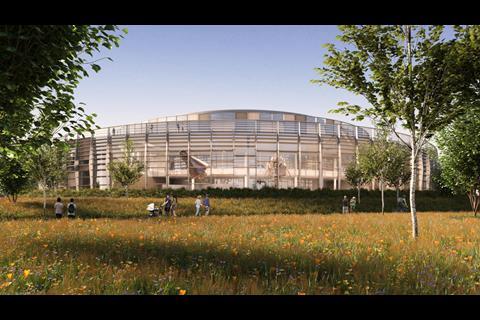
Good-quality architecture is a central part of this story, and has too often been overlooked in the past. Planning approval was recently secured for WilkinsonEyre’s designs for Marlow Studios, a campus that will help to lead the UK’s creative economy over the coming decades.
Marlow Studios is designed to attract the world’s top talent, and supported by a range of industry greats, including renowned film director James Cameron, as well as many local voices.
Through developments such as this, the UK is seeing at first hand how purpose-built, design-led creative infrastructure is central to national competitiveness. World-class studios are creative hubs that attract global investment, support skills and education – and reinforce the UK’s position as a leading destination for film and high-end television production.
The broader market context reinforces the direction of travel. According to the British Film Institute, UK film and high-end television production spend rose to about £5.5bn in the first nine months of 2025, up 17% on the same period in 2024. At the same time, the government has committed £380m of new investment for creative industries to boost research, innovation and regional creative clusters.
But rising demand only creates value if the infrastructure supporting it is fit for purpose, and today, much of the UK’s older studio stock is not.
Creative industries do not thrive in abstract policy frameworks alone. They rely on physical environments which support collaboration, new technology, skills learning, and long-term investment. They need to be great places to work.
As demand accelerates, the UK faces the challenge of delivering millions of square feet of new studio and production space in a way that enhances productivity, attracts talent and strengthens local economies. By the end of 2028, an additional 2.6million sq ft of purpose-built studio space is needed to meet demand and the projected £2.4bn increase in film and high-end television production spend.
Too many existing UK facilities fall short. Large, inward-looking industrial sheds with no relationship to their surroundings do little to support the people who work in them or the communities that host them. Design quality is not an aesthetic choice, it has a direct impact on performance, wellbeing and economic value.
Marlow Studios is conceived as a different response. Set on post-industrial land, the project demonstrates how thoughtful architecture can unlock complex sites and transform them into long-term assets.
Global production decisions are shaped not only by tax incentives, but by the quality of environments that bring people in; that support skills, wellbeing and collaboration
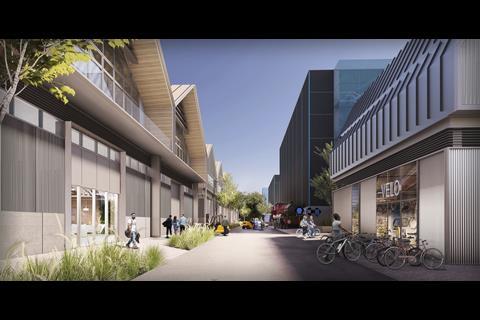
Rather than a single monolithic development, the scheme is structured as a series of clusters, with buildings of varying scale and typology, connected by landscaped streets and public routes. Studios sit alongside workshops, innovation spaces, education facilities, cultural venues and supporting amenity, creating a place that will operate year-round rather than only during production peaks.
This matters because creative growth is increasingly place-based. Global production decisions are shaped not only by tax incentives, but by the quality of environments that bring people in; that support skills, wellbeing and collaboration. Spatial quality influences how talent is attracted and retained, how efficiently production operates, and how confidently investors commit to the long term.
Architecture, in this context, becomes an economic tool. Well-designed studios, workshops and training spaces support skills development and productivity. Integrated cultural and community facilities help to anchor creative clusters within their local context.
Publicly accessible routes and landscapes build trust and connection, ensuring that major developments contribute to their surroundings rather than isolating themselves from them.
As competition for creative capital intensifies, so the quality of design is becoming a commercial differentiator. Countries which invest in flexible, generous and well-considered creative infrastructure will be best placed to capture long-term value. Those that prioritise speed or volume at the expense of quality risk undermining their own advantages.
So the challenge in 2026 is not whether the creative industries will continue to grow, but whether the UK will provide the environments they need in which to do so sustainably. Planning approval for projects like Marlow Studios is an important signal of intent. The next challenge is delivery at scale, with architecture placed firmly at the centre of the conversation.
If the UK wants to maintain its global edge, it must continue to see design not as an aesthetic extra, but as a strategic investment in one of its most successful growth sectors.
Postscript
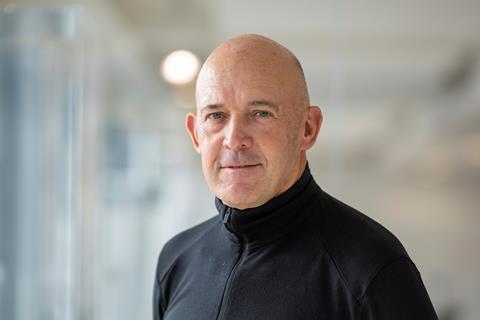
Oliver Tyler is managing director at WilkinsonEyre







No comments yet