









As regional mayors prepare to take control of funding for 16-19 education pathways following changes expected in next month’s Budget, Tom Lowe looks at the flagship Manchester scheme the new prime minister wants the rest of the country to copy
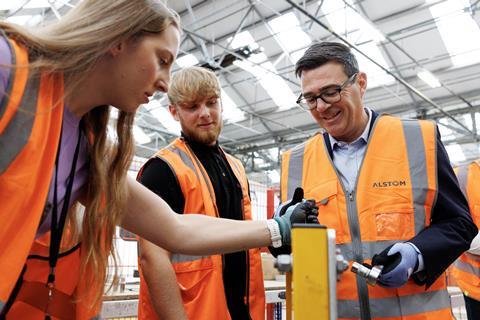
Another prime minister, another set of technical education reforms. It took Andy Burnham just 10 days in office to unveil his interpretation of what needs to be done to address the UK’s skills crisis. In doing so, he became the fifth PM in a decade to announce a shake-up of technical education, which hardly reflects well on the efforts of the previous four.
Burnham is expected to expand a version of the Greater Manchester Baccalaureate (MBacc) across the country, with details set to be announced in the autumn Budget on 28 October. The MBacc is a technical education framework that aims to provide clearer pathways between education and employment in seven work sectors, including construction. It is not a qualification, but a “line of sight” into employment for 14 to 19-year-olds which closely connects schools and colleges with the needs of local businesses.
The prime minister’s reforms will come just two years after the first academic year of MBacc delivery, in 2024/25, and the programme is still considered to be in its early stages. Figures from the Greater Manchester Combined Authority (GMCA) suggest that only around 100 of Greater Manchester’s 1,244 schools and 10 further education colleges are currently involved in MBacc projects as it heads into its third year.
How does the MBacc work?
The MBacc is not a qualification in itself. It is a framework which coordinates schools, colleges and employers in one of seven sectors, including construction, so that 14 to 19-year-olds on a technical path have a clear route from classroom to workplace.
In practice, this means structured work placements, employer contact and support alongside qualifications such as T-levels (two-year technical courses broadly equivalent to three A-levels), rather than students being left to find their own way into an apprenticeship or job.
Andy Burnham wants to take the model, first tested across Greater Manchester’s schools and colleges, and extend it nationally, with regional mayors given control of 16-19 funding to run it locally.
The seven gateways for students are: construction and the green economy; digital and technology; engineering and manufacturing; health and social care; financial and professional; education and early years; and creative, culture and sport.
Regardless, the speed of Burnham’s announcement in July shows his personal belief in the approach, which he took a lead in developing during his time as the mayor of Greater Manchester. Indeed, those who worked on the early development programme say it was envisaged as a pilot for a national programme almost from the start, with a model that could be easily adapted to other regions. That remains up for debate.
Conceived during Burnham’s first mayoral term, the MBacc grew from a series of research and working groups looking into why young people who underperformed on academic paths then often struggled to find work. It sought to address what Burnham called England’s “academic bias”, where education providers prioritise academic subjects such as English and maths over technical and vocational subjects.
This is a view that has long been shared by construction industry leaders who have seen little improvement in the sector’s skills crisis over recent years, despite a bewildering array of overlapping measures rolled out by the British state’s skills policy production line.
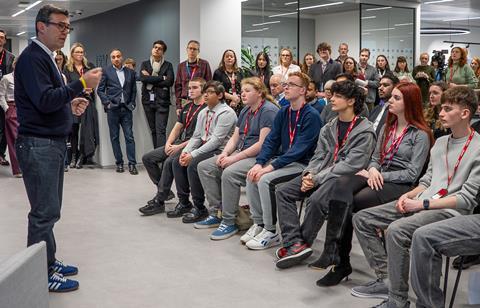
“The education system and the skills system are too often treated as separate worlds,” says CITB chief executive Tim Balcon. “Schools focus on academic attainment, colleges and providers deliver qualifications, employers recruit from whoever emerges at the end, and the individual is left to navigate the gaps in between. That sequence is failing employers as well as learners.”
Balcon believes technical and vocational learning should be part of education “much earlier” in a pupil’s journey through education, instead of being introduced at a later stage as the “second-best route for those who did not thrive academically”.
Working groups convened by the GMCA encountered similar issues in the education system during a three-year period of information gathering and policy development leading up to the announcement of the MBacc policy in May 2023.
Dawn Moore, people director at Murphy, was involved in these early meetings and saw how the framework took shape. “[For] many talented young people who didn’t want to follow the traditional academic paths or who couldn’t follow them for various social mobility reasons, those paths were failing to get them to work,” she says.
Burnham, who chaired these meetings, engaged key regional employers to lead the development of technical education standards for the seven sectors, with Moore asked to chair the construction workstream on behalf of Murphy.
Construction’s skills shortage in numbers
- 317,000 Additional construction workers needed to build 1.5 million homes
- 130,000 Additional construction workers needed to deliver the government’s warm Homes Plan
- 445,000 Additional construction workers needed to fulfill the government’s 2030 infrastructure commitments
- 45% Proportion of construction vacancies in 2024 left unfilled because applicants lacked the required skills
- £625m Funding committed by Keir Starmer’s government to achieve its target of 60,000 extra construction workers by 2029
- 42% Proportion of construction students qualified in 2020/21 who were working in a relevant occupation in 2021/22
- 75% Proportion of construction apprentices over the same period as above who were working in a relevant occupation
- 74 Number of young people who started Starmer’s construction foundation apprenticeship in 2025/26, against an assumption of 1,000
The GMCA’s approach was employer-led, starting with an analysis of the skills which employers needed rather than the skills which education providers thought they needed. But the standards also looked at how collaboration between employers, educational providers and young people could become far more of a partnership rather than three disjointed entities when it came to the process of finding work.
The workstreams also sought to bridge the gap from the perspective of young people by devising a more practical route into work. Years of research carried out by the GMCA prior to the start of policy development had found young people “just didn’t know where to look” for placements and apprenticeships.
“Employers would advertise opportunities, but not have a logical link to an educational partner to deliver, say, an apprenticeship standard,” Moore says.
One innovation was the creation of a shared portal, where all employers and education providers could post their opportunities as a “one-stop-shop” for young people choosing a technical rather than academic path.
For construction, one of the key issues Murphy sought to address was a lack of understanding around the breadth of roles available in the sector. While some roles require a degree, many do not, and it was the latter which the MBacc aimed to foster by improving access for people who may have performed less well in academic qualifications and did not continue on to university.
“It all goes back to first of all positioning the sector as something that potentially has an opening for everyone,” Moore says. “How do you close that gap for people who think, ‘I can’t go in there because I need to achieve education X’?
“Well the way you do that is by providing a number of different routes that aren’t necessarily traditional education. You have supplemental routes to those, and the MBacc was part of that.”

The first academic year for the MBacc opened in 2024, with 439 employers involved so far, pledging a total of 1,163 T-level placements on top of those sourced by colleges. The GMCA has a target for every school, college and special education provider in Greater Manchester to have an MBacc offer embedded into their curriculum by 2030. The authority says it is “well on track” to reach 50% of this target by July 2027, although it declined to provide the exact figure as of September 2026.
Its own count of 100 schools and colleges involved in the MBacc suggests the current number is less than 10%,
Part of the issue for the GMCA is that it has limited ability to tell schools what to do; central government controls schools policy through the Department for Education. The latter is currently engaged in a review of the national curriculum, commissioned in July 2024 in the first weeks of Keir Starmer’s government, which is set to decide the future of the English Baccalaureate, an academic performance measure which has been criticised, including by Burnham, for discouraging take-up of vocational subjects.
Schools have only so much time and capacity. There is a limit to how many different things they can do
Pepe Di’Iasio, Association of School and College Leaders
This review has led to considerable confusion during the first two years of the MBacc, with schools being pulled in two different directions as the future of education policy remained up in the air.
Pepe Di’Iasio, general secretary of the Association of School and College Leaders, says it was unclear how Burnham’s reforms would fit in alongside the curriculum and assessment review and existing academic and vocational routes. “Schools have only so much time and capacity. There is a limit to how many different things they can do. Right now they have very little concrete information to work from,” he says.
Technical education reforms over the past 10 years and over four administrations
Theresa May
- 2016 Laid the groundwork for T-levels
- 2017 Established Institutes of Technology, specialist schools offering higher-level STEM and technical skills
- 2017 Reformed the Apprenticeship Levy
Boris Johnson
- 2020 Oversaw first rollout of T-levels
- 2020 Launched skills bootcamps, short courses aiming to upskill young adults aged over 19
- 2022 Skills and Post‑16 Education Act (2022) created local skills improvement plans and reformed technical qualification regulation to boost employer‑aligned technical routes.
Rishi Sunak
- 2023 Proposed the Advanced British Standard, a post-16 system combining academic and technical studies
- 2024 Fully funded apprenticeships for under 21s placed with SMEs
Keir Starmer
- 2024 Replaced the Apprenticeship Levy with the Growth and Skills Levy
- 2024 Introduced Foundation Apprenticeships for young people
- 2024 Established Skills England, a new body which identifies skills shortages and sets national skills targets
- 2025 Created 14 Technical Excellence Colleges to expand high-level technical education in England
Burnham’s elevation to Number 10 may provide some clarity on the issue, with the former GMCA mayor’s backing for an MBacc on a national level likely to give the policy greater weight in the meantime for schools which remain wary. But a national roll-out would present new challenges, not least the issue of how a programme developed for the specific context of Greater Manchester, with its particular concentration of business sectors, can be adapted to other regions.
Di’Iasio says: “Greater Manchester is a fast-growing economy with a diverse range of industries, and it’s unclear how this approach would work in other places. It might be more challenging in rural areas, for example, to forge the necessary links with employers.”
Regional leadership structures also present complications. Burnham has said that he wants to hand control of education funding for 16 to 19-year-olds to regional mayors. But many areas do not yet have such a leadership structure, consisting of a mayor and a strategic authority which would be responsible for coordinating an MBacc-inspired programme.
According to Moore, Burnham has long held an ambition for the MBacc to become a national policy. “I remember being in the same room as Andy Burnham, where he said, ‘this needs and will become a national set of standards. He said, ‘I have the other mayors on board, and this is something this country needs’,” she recalls.
Some clarity over how the approach will be deployed in those parts of the country currently without regional mayors is one of many aspects of the reforms which will be needed when more details are fleshed out at the autumn Budget.
Of course we need to address problems where they arise but less chopping and changing please – no one can keep up!
Suzannah Nichol, Build UK
Schools, employers and young people will also be hoping that Burnham’s interventions do not further confuse the existing landscape for technical and vocational pathways. Build UK chief executive Suzannah Nichol says the construction industry will be broadly supportive of Burnham’s goals but urges the prime minister to ensure the reforms provide certainty.
“It takes time for employers of all sizes to adapt to changes, so of course we need to address problems where they arise but less chopping and changing please – no one can keep up!” she says.
From Theresa May’s T-levels, to Boris Johnson’s skills bootcamps and Keir Starmer’s creation of Skills England to the announcement of V-levels – a vocational replacement for BTECs set to launch next year – a succession of governments has introduced substantial complexity into the technical education landscape which now threatens to be counter-productive to the aim of getting more young people into a non-academic career path.
Judith Topley is an architect and former practice director at Morris + Company who now advises secondary schools in south London on career paths for young people. “What has come to my understanding over the last six months is how swamped schools are with all the requirements, continual levels and levels and levels,” she says.
And, while the pathways on offer can be confusing for both students and teachers, it is as much a problem for parents, many of whom are hazy on exactly what T-levels are and wary of letting their children opt for an apprenticeship over the tried-and-tested university route.
As Topley points out: “When you speak to those young people, you hear the battles that they went through at school and with their parents to convince them that being an apprentice was OK. Because an apprenticeship has connotations that you are going to be a plumber or something completely non-academic, whereas that’s not the case now.”
CIOB head of policy and public affairs David Barnes believes the complexity, newness and unfamiliarity of the current technical education framework is contributing to a lack of engagement from schools, students and parents. “I think one of the biggest consistent problems is sometimes [governments] just simply reinventing the wheel, or just repackaging similar kinds of concepts, and often this creates a bit of a confusing landscape for a lot of younger people,” he says.
“There are lots of leftover pieces that have been forgotten and have probably not had that longer-term focus.”
He adds: “The framework is still a bit complex. It’s always a brand new scheme rather than just keeping it and letting it almost work. You’ve got to have that repetition to actually make sure there’s consistency in the advice that we are giving.”

Preconceptions around T-levels can become a self-fulfilling prophecy, with some schools seeing the qualifications as a last resort for poorer performing students. “You get some really high-performing children who will choose a T-level route,” says Alison Watson, founder of Class Of Your Own, a social enterprise that provides education programmes for the built environment sector. “But you’ll also get some kids who are actually, and still to this day, shuffled into a T-level route because they’re not going to perform well in A-level.”
We’ve had really fantastic young people who are ready to go, who want a degree apprenticeship – but they can’t get one for love nor money
Alison Watson, Class of Your Own
The other side of the equation is a lack of engagement from employers, who provide both apprenticeships and the incentive for young people to opt for the technical route. While many of the larger construction companies including Mace and Kier have long-established and respected apprenticeship programmes, these types of companies make up less than 1% of the UK construction industry, according to ONS figures. If the government wants more young people to enter the construction industry, it will need to do a better job of incentivising smaller companies to take on apprentices.
“We’ve had some real issues in the past where we’ve had really fantastic young people who are ready to go, who want a degree apprenticeship – but they can’t get one for love nor money,” says Watson.
There are many reasons why SMEs might not be offering apprenticeships on the scale that the government wants. Many do not have the resources to engage with schools or colleges over potential candidates, particularly if the schools themselves are not clear on what apprenticeship schemes are on offer.
“What might work for a massive company with, say, hundreds or thousands of employees, smaller companies probably don’t have the resource to implement a lot of those skills initiatives or take on apprenticeships,” says Richard Cook, senior economics director at development consultancy Pegasus Group. Any approach taken by Burnham on apprenticeships “can’t just be a one size fits all sort of intervention”, he adds.
If and when they do take on apprentices, businesses often find that they train them up only for them to abandon the scheme halfway through because of a lack of clear career prospects at the end. When there is a job lined up for them at the apprenticeship-providing SME, many apprentices either leave to become self-employed or get snapped up by bigger companies offering higher salaries.
“What happens a lot of the time is you’ll see these big infrastructure projects such as HS2, where they’ll say we can offer a lot more money, so we’ll just nick someone who’s ready-made, who’s trained somewhere else, and then we can get them on site. And then the smaller company might just think, ‘why do I bother?’ ” says Barnes.
A report by the National Audit Office in July found that around 45% of construction vacancies in 2024 remained unfilled because applicants lacked the required skills. The same report found 42% of construction students who qualified in 2020/21 were working in a relevant occupation the following year, compared to 75% of construction apprentices over the same period.
It is very clear that reform of the system is needed. The test will be whether this government can make thse latest reforms stick for long enough to make a lasting impact.







No comments yet