

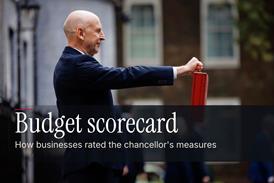







John Healey’s first Budget under Andy Burnham’s premiership won cautious approval from construction, scoring an average of 5.9 out of 10. Carl Brown reports on how a cross section of industry leaders rated the chancellor’s package across nine key themes - from retrofit and infrastructure to housebuilding and skills
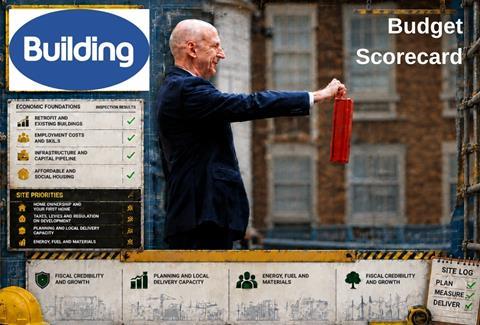
After weeks of build-up, John Healey delivered the first Budget of Andy Burnham’s premiership on 28 October.
Much of the national media’s initial coverage focused on cash payments to help people with their energy bills, as part of the chancellor’s plan to give “breathing space” to households amid fears we are entering a new phase of the cost of living crisis.
For those working in construction the interest is on wider measures in the Budget, and although thinktanks such as the Resolution Foundation described them as “scattergun” industry leaders were looking for signs they could help businesses escape the doldrums of recent years.
There was no shortage of announcements that, on the face of it, could do just that, including freezing housebuilding regulations and removing biodiversity net gain (BNG) rules on smaller brownfield sites along with plans to devolve funding, extra grant for social housing, a roadmap for fiscal devolution, a housing equity loan scheme and a new data centre covenant.
The question is whether these measures add up to generating the conditions for growth and increased construction activity. Did the industry get what it had been hoping for and what it needs?
To gauge this Building Design’s sister publication Building asked experts from across the built environment to assess the government’s performance against their key asks before the Budget. We asked them to score Healey’s package of measures out of 10 and to assess the impact across nine different areas.
A total of 29 different respondents took part in our Budget Scorecard exercise.
Budget Scorecard methodology
Building received responses from 29 different cross-industry leaders. They represented:
- 11 consultants
- Seven architects
- Four contractors
- Four trade/membership bodies
- One housebuilder
- One housing association
- One procurement authority.
Respondents were asked to score the overall Budget out of 10, and say whether their top asks had been met and why. They were also given the option of giving a score out of three for delivery in nine different areas.
Very few respondents were wholly satisfied that their top asks had been met, just two organisations answered “yes” to that question. But more than half (15) say their asks had been partly met, while 11 answered “no”.
The overall average score out of 10 for the Budget was just under 6 (5.9).
However within that overall view, satisfaction varied by sector or theme (see chart below). We asked the respondents to give a mark on scale from zero to three against nine themes, where zero means the Budget has made things worse and three means pledges are fully delivered (specific, funded and timetabled).
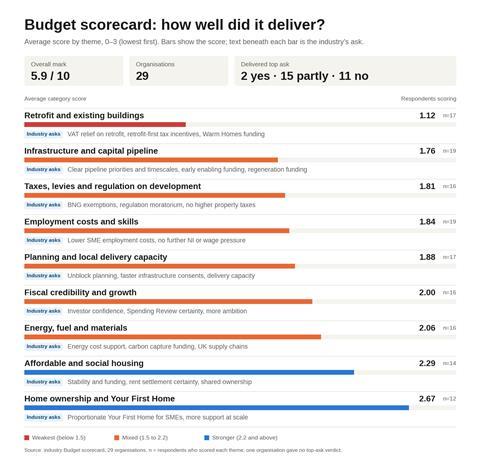
The survey shows the highest satisfaction was with the Budget’s key housing announcements. Its home ownership announcements, including the Your First Home equity loan scheme, received the highest average score among our respondents at 2.67 out of 3. This was followed by a score of 2.29 for affordable and social housing policies and 2.06 for energy, fuel and growth policies.
The lowest score was for retrofit, which averaged 1.12, while infrastructure and capital pipeline also received a comparatively low score of 1.76.
The thinking behind the scores
Here are some of the respondent’s thoughts on the Budget announcements in the various topics, starting with the lowest-scored areas.
Retrofit and existing buildings (Average score: 1.12 out of 3)
When it comes to retrofit and existing buildings 13 out of the 17 respondents to mark that theme gave a score of 1 meaning the Budget measures will make no change or the topic was not addressed.
Oliver Milton, managing pa rtner at architect Hawkins/Brown, says: “There were no measures in the Budget to make retrofit more commercially viable by reducing VAT on qualifying retrofit and energy-efficiency works.”
This Budget fell short on sustainability, with no positive tax incentives to support a retrofit-first approach
Colin McColl, Orms
This was echoed by Colin McColl, director of Orms, says: “This Budget fell short on sustainability, with no positive tax incentives to support a retrofit-first approach.”
Pierre Wassenaar, chair of Stride Treglown also notes the Budget had ”almost nothing for existing buildings”.
Infrastructure and capital pipeline (Average score: 1.76 out of 3)
Infrastructure and capital pipeline was the topic, along with employment cost and skills, that was scored by the most respondents (19) indicating its importance to the industry. Certainty around funding priorities and timescales was mentioned by several respondents.
Hughie Clarke, director at consultancy Edge, says: ”The Budget contains welcome commitments on planning reform, housing delivery and regional growth, but the industry still needs greater certainty that projects can move through the system more quickly and be delivered efficiently.”
John Wilkinson, chief operating officer at BAM UK and Ireland, says: ”The real measure of this Budget will be what gets built, not just what gets announced. Investment must translate into projects that create jobs, strengthen communities and deliver lasting economic value.”
Stuart Syddell, partner at Stace, says: ”The chancellor has given the sector some genuine reasons for optimism, but demand is being stimulated while costs continue to rise. The government must now focus on viability and delivery if it wants investment to translate into new homes and infrastructure.”
We’re now in a holding pattern awaiting decisions in the Spending Review – construction needs much greater certainty on funding, pipeline and delivery to be able to commit and invest
Stephanie Marshall, Turner & Townsend
Stephanie Marshall, managing director, UK at Turner & Townsend, says: ”The Budget included some welcome interventions, but we’re now in a holding pattern awaiting decisions in the Spending Review – construction needs much greater certainty on funding, pipeline and delivery to be able to commit and invest.”
Ben Goodwin, director of policy and public affairs at CECA, says: ”There was a commitment in the Budget to publish a new Infrastructure Pipeline and to speed up infrastructure planning, but the practical utility of the former will not be clear until we’ve seen it and the proof will also be in the pudding with the latter.”
Andrew Reynolds, chief executive, UK and Europe at Rider Levett Bucknall (RLB), says: ”The Chancellor’s confirmation of the Good Growth Fund, energy market reforms, the Data Centre Covenant and increased defence spending signals a clear commitment to strengthening the UK’s long-term infrastructure pipeline. Collectively, these measures have the potential to boost investor confidence, unlock new opportunities across the built environment and create the conditions for sustainable economic growth.”
Taxes, levies and regulation on development (Average score: 1.81 out of 3)
Healey’s headline Budget measures were aimed at individual households, but there was a feeling among the respondents that there was little in the Budget in the way of changes to taxes or regulation to incentivise business growth.
Dan Weiss, managing director, consulting at Bellrock describes it as a “a relatively cautious Budget offering short-term relief to households but no fundamental resolution for current (and forecast) weak economic growth or pressure on public finances.”
Healey did however announce the removal of biodiversity net gain (BNG) on smaller brownfield sites and pledged no further changes to building regulations this parliament (with the exception of building safety). Steven McGee, chief operating officer, construction division (UK and Ireland) Sisk,says the latter “sends a positive signal to industry.”
Overall more positive than anticipated and a step in the right direction
Paul Rickard, Pocket Living
Paul Rickard, chief executive of housing developer Pocket Living, says: ”Overall more positive than anticipated and a step in the right direction. We need to build on this for a fully distinct regulatory, taxation, and policy regime appropriate to the size and delivery record of SME homebuilders to make the development model viable again.”
Hawkins/Brown’s Milton says: ”There was little in the Budget for the construction industry to get excited about, but equally nothing that should upset the fragile momentum we are beginning to see. It is disappointing that there were no more radical measures to stimulate growth, such as changes to VAT on retrofit, but few expected them.”
Employment costs and skills (Average score: 1.84 out of 3)
The Budget including a rise to the national living wage and national minimum wage of 3.9%, which will represent further costs for business.
Gaauri Lamb, chief executive at FHP Group, says: “[This was] a Budget of teasers rather than tools. It offers the illusion of support, yet the qualifying hurdles keep real relief out of reach for the SMEs who employ most of Britain’s workforce.”
Healey said Alan Milburn’s report into why so many 18 to 24 year olds are not in education, employment or training will be published next month, after which we may expect some more concrete policies on skills. But he did say in his Budget that “large government construction and infrastructure projects” will require at least 3% of the workforce on those jobs to be apprentices. The Budget also said the government is providing £100m of funding across 2027-28 and 2028-29 to expand Mayoral Apprenticeship Brokerage Pilots from seven to 14 Mayoral Strategic Authorities across England.
We’re particularly pleased to see additional funding for Leeds College of Building
John Wilkinson, BAM UK & Ireland
BAM UK & Ireland’s Wilkinson says: “Investment in construction skills is essential to delivering the UK’s infrastructure ambitions, and we’re particularly pleased to see additional funding for Leeds College of Building, our award-winning apprenticeship training partner of more than a decade, with whom we’ve trained 653 apprentices.”
McGee adds: ”To sustain momentum, further action on skills, employment costs and development viability will be needed to unlock the sector’s full potential.”
Planning and local delivery capacity (Average score: 1.88 out of 3)
The Budget contained little in the way of new planning policy, beyond the changes to BNG and the pledge not to bring in more housebuilding regulations. The Budget did contain pledges to speed up planning through the use of AI tools and better digitialisation while outlining previously announced plans for legislation to reduce the risk of legal challenges delaying essential infrastructure projects.
Labour has already carried out a significant number of changes to the National Planning Policy Framework. The key issue now might be capacity.
RLB’s Reynolds says: ”The ambition outlined from the chancellor is not in question. The challenge is implementation: creating the certainty, capability and capacity needed to turn policy commitments into real projects and economic growth.”

Fiscal credibility and growth (2.0 out of 3)
The Budget was seen as being fairly risk averse, with the government keen to avoid the mistakes of previous administrations. Ministers did not make the mistake of talking the economy down in the run-up to the fiscal event and anything that could spook the bond markets Liz Truss-style was avoided. However, with the government’s fiscal headroom reducing, historically high welfare spending and the need to increase defence commitments, the government’s fiscal position did not feel particularly strong, while there was a sense that the Budget did not provide the stability and certainty the construction industry needs.
Marshall of Turner & Townsend, said: “The Budget largely maintained existing commitments, but the reduced fiscal headroom and next year’s Spending Review still leave businesses without the certainty and confidence they need to invest confidently.”
BAM’s Wilkinson said: “The UK’s £718 billion infrastructure pipeline represents an enormous opportunity for economic growth, but the Budget falls short of providing the clarity on project priorities, funding and delivery timescales that industry needs to invest with confidence.”
Meliha Duymaz, chief financial officer at Skanska UK, said: “I welcome the Government’s commitment to infrastructure investment and devolution and look forward to further detail from NISTA, providing the certainty businesses need to invest in people, skills and future infrastructure delivery”
Energy, fuel and materials (Average score: 2.06 out of 3)
When it comes to materials, Martin Casey, senior director of cement and lime at the Mineral Products Association was disappointed by the lack of measures to help that the products and manufacturing part of the construction industry.
He says: ”This wasn’t the growth engine the construction supply chain needs, and the chancellor could have done more to give materials makers confidence in the pipeline and tackle competitiveness issues like high energy costs.”
Duymaz of Skanska UK, says: ”There weren’t many extra taxes on business but no support for rising energy costs which has a major impact on our sector.”
Félicie Krikler, director and head of residential at architect practice Barr Gazetas, detected that Healey considers energy a priority. She says: “The structure of the speech itself was interesting, beginning and ending with the two issues that often matter most to the built environment: energy for starters and housing for dessert, introduced with ‘home is at the heart of our lives’”.
Affordable and social housing (Average score: 2.29 out of 3)
Affordable and social housing was judged by our respondents to have done relatively well out of the Budget with an average score of 2.29 and about a third of the respondents to have scored the topic (five out of 14) awarding it the top 3 rating, meaning pledges have been delivered.
Certainly the extra £1.5bn for Social and Affordable Homes Programme was welcomed as was the decision to apply a zero rate of VAT to land bought by housing associations. Respondents were also happy that there were no changes to current, hard-won wins on policy such as the 10-year social housing rent settlement.
The Budget offers policy consistency at a time of considerable political and economic flux, while also offering some useful supply- and demand- side measures
Paul Hackett, chief executive of Southern Housing
Paul Hackett, chief executive of Southern Housing, says: ”[Before the Budget] I set out Southern Housing’s hope for a ‘steady the ship’ Budget. And that is exactly what we got. The Budget offers policy consistency at a time of considerable political and economic flux, while also offering some useful supply- and demand- side measures.”
Helen Collins, principal and head of UK Living and affordable housing at Avison Young, questioned whether the government is moving quickly enough to allocate funding to registered providers with capacity to build.
She says: ”Extra SAHP funding is good news but still leaves around 28,000 deliverable homes unfunded and large capable delivery partners without the funding certainty of a Strategic Partnership deal.”
Tracy Harrison, chief executive of the Northern Housing Consortium, says: ”The Budget did not address the current funding gap for regeneration, but greater devolution lays strong foundations for addressing the issue in the future.”
Some of the individual social housing policies were popular among the respondents but there was also a concern about wider housebuilding market difficulties and their potential to choke off delivery.
Syddell says: ”The additional £1.5bn for social and affordable housing is welcome, however, higher property taxes, ongoing viability pressures and delays to major infrastructure projects now risk holding back the wider investment needed to translate this into a substantial increase in housing supply. The industry needs a broader package of measures to restore confidence and bring forward development at scale.”
Home ownership and Your First Home (Average score: 2.67 out of 3)
The high average score for home ownership suggests industry leaders were relatively impressed by the Budget’s measures to get people on the housing ladder, including the Your First Home equity loan scheme for first-time buyers. Some extra detail, on the scheme’s fees, timeline and indication of maximum property purchase price caps was released alongside the Budget.
Pocket Living’s Rickard says: ”We’re pleased the government has listened and made Your First Home tiered and proportionate for SMEs.”
However, the scheme is certainly not being seen as a panacea to the UK’s ailing housebuilding market.
Sally Lewis, principal at Broadway Malyan, says: ”The Budget offers some help, but it won’t close the viability gap that’s stalling housing development in London. The Your First Home measures are unlikely to unlock city flats built for sale, given weak buyer demand for leasehold properties.”
McGee of Sisk says: ”The Budget takes positive steps to improve access to home ownership through the Your First Home scheme and additional investment in Affordable Housing but the scale of the challenge means significant more supports are required.”
Contributors
Building would like to thank all 29 respondents for taking part in Building’s Budget Scorecard.
| Name | Title | Organisation |
|---|---|---|
| Lee Powell | managing director | HBC Construction |
| Hughie Clarke | director | Edge |
| Olivia Jackson | associate regeneration lead | HLM |
| Mark Dewhurst | Manchester office managing partner | Ridge |
| Meliha Duymaz | chief financial officer | Skanska |
| Martin Casey | senior director of cement and lime | Mineral Products Association |
| Helen Collins | principal and head of UK Living and affordable housing | Avison Young |
| Paul Hackett, | chief executive | Southern Housing |
| Dr David Crosthwaite, chief economist at BCIS | chief economist | BCIS |
| Sally Lewis | principal | Broadway Malyan |
| Gaauri Lamb | chief executive | FHP Group |
| Ben Goodwin | director of policy and public affairs | CECA |
| Richard Steer | chair | Gleeds |
| Dan Weiss | managing director, consulting | Bellrock |
| Tracy Harrison | chief executive | Northern Housing Consortium |
| Andrew Reynolds | chief executive, UK and Europe | Rider Levett Bucknall |
| Stephanie Marshall | managing director, UK real estate cost management | Turner & Townsend |
| Colin McColl | director | Orms |
| Holly Lewis | co-founding partner | We Made That |
| Félicie Krikler | director and head of residential | Barr Gazetas |
| Pierre Wassenaar | chair | Stride Treglown |
| Caroline Compton-James | deputy chief executive | SCAPE |
| Paul Rickard | chief executive | Pocket Living |
| Steven McGee | chief operating officer, construction division (UK and Ireland) | Sisk |
| Matt Keen | senior vice president, construction | Causeway Technologies |
| John Wilkinson | chief operating officer | BAM UK and Ireland |
| Spokesperson | Spokesperson | UK Green Building Council |
| Oliver Milton | managing partner | Hawkins\Brown |
| Stuart Syddell | partner | Stace |







No comments yet