

As facade performance targets and construction efficiency increasingly top the agenda in projects, the importance of what sits behind the facade has never been more significant – especially the support structure
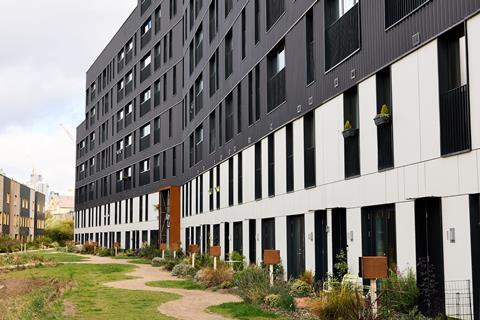
By choosing the CROSSFIX all-stainless steel substructure system from EJOT, architects and facade engineers can create higher performing, more sustainable and stronger rear ventilated or rainscreen facades – with the added benefits of greater design flexibility and process efficiency.
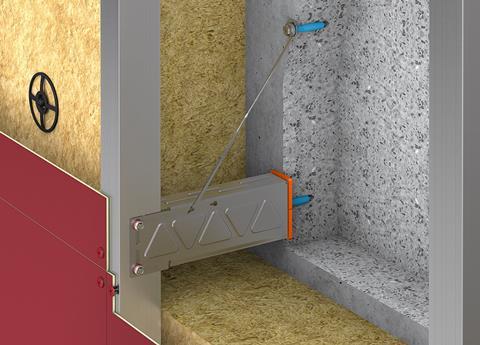
A complete framing system, backed with a comprehensive European Technical Assessment (ETA) to independently confirm its performance, CROSSFIX is compatible with all building substrates, insulation materials and cladding. It is supplied as a package including all the brackets, rails, anchors and fasteners required to assemble a robust sub-frame, plus an optional “Powerkey” to optimise load distribution between anchors.
The system achieves significantly higher load-bearing capacities compared to other substructures, but its innovative design offers more than greater structural strength and stability. The system enables enhanced performance and sustainability targets to be achieved that benefit the building more broadly, as well as allowing the design and build process to be streamlined.
Stainless steel as a sustainable facade enabler
One of the major advantages offered by CROSSFIX is its stainless steel composition. This offers major advantages versus aluminium substructure systems in respect of its strength, thermal conductivity and embodied carbon. As a result, stainless steel substructures like CROSSFIX are better aligned with today’s building design goals – especially creating highly insulated walls and maximising facade durability.
Stainless steel’s low thermal conductivity compared to aluminium means a lower amount of heat transfers through each CROSSFIX bracket versus aluminium alternatives, making it valuable in reducing the building’s heat loss and gain.
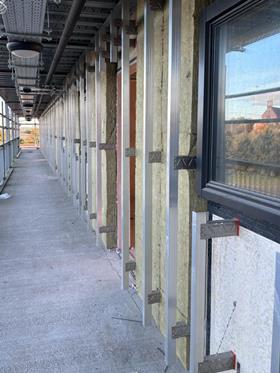
An additional thermal benefit comes with the material’s increased strength. Compared to a substructure created using a standard aluminium system, fewer brackets are required for CROSSFIX – that means fewer structural connections from the building substrate to the outer sheet and a further reduction in thermal bridging. And with fewer brackets and rails to connect, substructure assembly time and cost can also be reduced.
Potential for thinner walls and resource savings
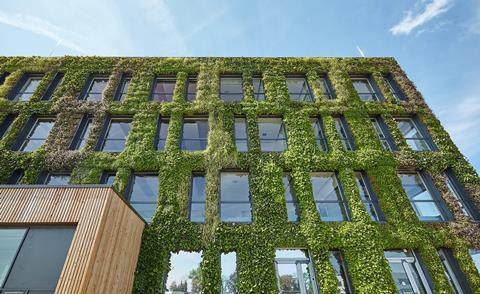
Such is the effect of thermal bridge reduction when using CROSSFIX – which has the added benefit of a polyamide thermal stop to further reduce heat transmission – that the depth of insulation can actually be decreased in a facade without compromising U-values. This means wall thickness can be reduced, increasing floor space within the building and saving on insulation use.
Easy recoverability and recycling of stainless steel at the end of the facade’s lifespan – as well as reduced energy use in its initial manufacture compared to aluminium – further strengthen the sustainability credentials of CROSSFIX, which can be seen in the system’s environmental product declarations (EPDs).
It all adds to its suitability for projects being constructed in line with internationally recognised schemes such as BREEAM and LEED, as well as Passivhaus schemes through its certification in Germany.
Increased design flexibility through vertical and horizontal compatibility
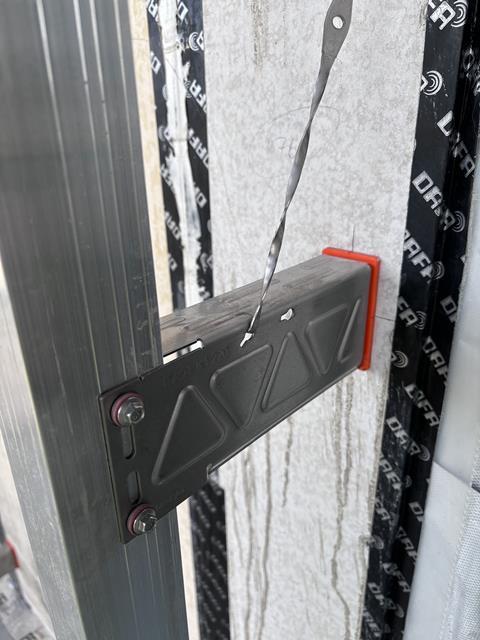
The Konsole bracket of CROSSFIX is engineered in a way that means it can be used with both vertical and horizontal rails. By enabling the use of vertical and horizontal rails in a single bracket, designers and facade engineers have the freedom to match the rail orientation to the cladding format and optimise fixing locations for aesthetic joint alignment.
It also makes adapting to complex geometries, facade setbacks and mixed cladding systems on the same building more straightforward, providing flexibility that can be especially useful on projects where facade materials change late in the design process.
Achieving more demanding fire safety standards
CROSSFIX’s stainless steel composition is also ideally suited to construction’s new building safety regime, particularly in respect of its ability to withstand high temperatures.
Importantly, stainless steel retains a high degree of mechanical strength durability at high temperatures – for example, at 700°C the substructure retains 55% of its strength. As a result, the system is classified with an A1 fire rating according to EN 13501-1, the highest possible classification for non-combustible materials, signifying that it does not contribute to the spread of fire.
Discover CROSSFIX at Zak World of Facades
Attendees at the Zak World of Facades event in Manchester in June will be able to find out more about the contribution that CROSSFIX could make to their facade projects. The EJOT UK team will be exhibiting to give architects and facade designers the opportunity to discuss the technical characteristics of the system and its design features in depth.
Find out more about CROSSFIX here.