Ike Ijeh tours the planet to report on this year’s most anticipated completions

Grand Egyptian Museum | Heneghan Peng
Giza, Egypt
By the time the much-delayed Grand Egyptian Museum is completed later this year, not only will it be the largest archaeological museum in the world but it will have taken almost as long to build as the Great Pyramid of Giza which it is meant to celebrate.
But in all probability this merely increases the anticipation for what it likely to be the world’s most eagerly awaited cultural opening of the year. When the foundation stone was first laid in 2002 it was intended that the venue would open in 2013. But a catastrophically disruptive cycle of recession and revolution over the subsequent decades meant that the project was successively delayed. Opening dates were mooted in 2017, 2018 and 2019 but, with the structure now fully complete, this year looks set to be the one when the £750m mega-project is finally unveiled.
Covering a colossal 5m ft² the museum is more than six times bigger than Europe’s largest museum (the British Museum) and will contain more than 100,000 previously un-displayed treasures from the ancient Pharonic period.
Engineered in conjunction with Arup, the museum’s vast spaces and colossal partially exposed concrete frame seek to capture the majestic scale and awesome monumentality of the iconic structures it seeks to commemorate.

Brandenburg Airport | Gerkan, Marg & Partners
Berlin, Germany
It is nothing short of miraculous how Germany’s hard-earnt international reputation for efficiency and expertise has been maintained in the face of what must count as one of Europe’s most disastrous large-scale public projects for a generation.
Initially planned to open in October 2011, Germany’s largest airport has been hit by a catastrophic series of delays, disputes and technical failures that has seen costs almost quadruple to €8bn and has even left a former technical director with a suspended jail sentence for fraud and corruption.
Many of the problems have centred on cabling, ductwork and electrics which means that the actual airport structure was completed years ago and requires a team of operatives to rotate luggage carousels and turn on taps to ensure that services do not seize up. Consequently the empty airport consumes more energy than Berlin’s operational second airport (Tegal) and costs a staggering £18m a month to run despite not ever having hosted a single passenger.
2017 was the last official missed opening date but the owners are confident that 2020 will be the year when Germany finally puts its biggest construction nightmare of recent times to bed once and for all. When it does open, it is unlikely its largely mundane architecture is going to be memorable enough to erase memories of its tumultuous gestation any time soon, despite the fact that the design team cites Bauhaus and the celebrated 19th-century neo-classicist Schinkel as influences.

Marble Arch Place | Rafael Viñoly
London, UK
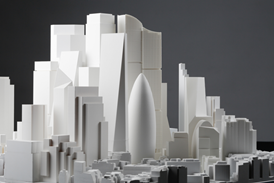
Unperturbed by the Walkie Talkie’s coruscating Carbuncle Cup victory in 2015 or the controversy over his masterplan and residential buildings for the Battersea Power Station redevelopment, Rafael Viñoly has returned to London with yet another high-profile building in a historic location. Teaming up with developer Almacantar whose residential refurbishment of Centre Point has already given them a landmark at the eastern end of Oxford Street, the developer now bookends the western end with its £450m redevelopment of the former Marble Arch Tower site.
Sadly the decision was taken to compound rather resolve the 1960s planning mistake that saw TP Bennett’s original 1966 structure tower over Nash’s 1827 Marble Arch and here too the scheme retains a high-rise element that holds unwarranted prominence over a site of major civic and historic importance. Equally, the introduction of yet another luxury residential tall building is not one that London, with its ongoing housing crisis, is likely to welcome.
Nevertheless, in its efficient if rather pedantic execution of new facades and the welcome introduction of a new public route bisecting the development, the office, retail and resi scheme will be a key player in the ongoing revamp of Oxford Street and marks yet another important chapter in Viñoly’s UK portfolio.

Olympic Stadium | Kengo Kuma
Tokyo, Japan
2020 is an OIympic year and it is Tokyo’s turn to take over the mantle from Rio in 2016 and London in 2012. As with every Olympics the showcase venue is the Olympic Stadium and here one of Japan’s most celebrated architects – best known to British audiences for his V&A Dundee) has designed a stadium that is the largest in the country and which, after the games, will be known as Japan’s National Stadium.
The triple-tiered 80,000-seat stadium stands out on the world sporting stage because unlike most stadiums it is not primarily constructed from steel or concrete but from wood. Accordingly, it is an altogether more traditional composition than one might expect for a large modern sporting venue, with its timber and steel hybrid structure inspired by traditional Japanese temples and incorporating cedar and larch from all of Japan’s 47 prefectures.

Despite its soft, naturalistic character the project has not come without controversy. Zaha Hadid’s original designs for the stadium were famously scrapped in 2015 on the grounds of cost and Hadid subsequently accused Kuma of plagiarising elements of her design, a claim strongly refuted by Kuma.
Unimpressed locals have also nicknamed it “the hamburger”.

Maggie’s Southampton | AL_A
Southampton, Hampshire
After a quiet couple of years, the rolling series of Maggie’s Centre commissions providing pastoral cancer care is set to steal the limelight again this year, with two centres designed by keynote architects completing. Thomas Heatherwick’s Maggie’s Yorkshire will open within the precinct of St James’s University Hospital in Leeds with its staggered, overlapping series of planted ribbed alcove structures accommodating 10,000 plants and providing a highly naturalistic version of the intimacy and enclosure that Maggie’s is now renowned for.

And first, this spring, Amanda Levete’s centre will open on the grounds of Southampton General Hospital. Levete’s offering aims to create a discreet sanctuary that uses daylight, enclosure and a subtly reflective envelope to being “ethereal clarity” to the centre’s patients and their families. In a common Maggie’s theme, it is again set within a sheltered planted garden.
Both centres look set to maintain Maggie’s reputation for recreating inspiring, inviting and humanistic contemporary architecture within a format where every project remains individualistic and unique.

The Factory | OMA
Manchester, Greater Manchester
2020 looks set to be a bumper year for Rem Koolhaas’ seminal Dutch architecture collective with a slew of projects completing across the world. Its School of Science and Sports at Brighton College and the New Museum of Western Australia have already opened in the UK and Perth respectively and the practice’s vast expansion of the Axel Springer multimedia campus opens in Berlin this spring.
Its Manchester Factory may be a significantly smaller project but it does not come without controversy. The £130m cultural and theatre venue has already gone significantly over budget and cost warnings last year intimated strongly that costs may rise further. Additionally, the complex’s design has also come in for criticism with its garish assortment of shapes, colours and geometries falling somewhere between Alsop, avant-garde and awkwardness.
Nonetheless the centre is slated to play a major role in the north-west’s art scene when it opens in September and it is also expected to be one of the key venues for Manchester’s 2021 International Festival.

Newfoundland Quay | Horden Cherry Lee
London
A new skyscraper in Canary Wharf is hardly headline news. But when that tower is the second tallest on the peninsula and, even more significantly, is a residential rather than office tower then it is clear that 60-storey Newfoundland Quay means that some kind of change is afoot.
For the past 32 years Canary Wharf has prided itself on being an exclusively financial and commercial district with its famous skyline of skyscrapers solely occupied by offices.
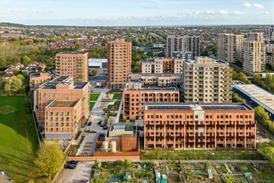
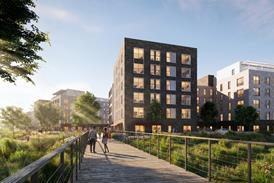
The next generation of Canary Wharf development is set to change that and on Wood Wharf, the new 23-acre £2bn mixed-use development being built by the Canary Wharf Group beside Canary Wharf, 3,300 new homes are planned.
But Newfoundland Quay is significant because it is not actually located on Wood Wharf but Canary Wharf itself and thereby forms the only residential component on the peninsula.
In another novel development, all its 636 flats have been allocated for the private rental sector, a sector that will in itself account for around two thirds of Wood Wharf’s housing. Accordingly, not only is Newfoundland Quay Britain’s tallest rental block, it also marks a historic cultural and economic change in arguably Britain’s defining late-20th-century urban regeneration project.

Lambeth Palace Library | Wright & Wright
London
Opportunities to expand iconic nationally historic buildings do not come often. It is 18 years since John Simpson expanded the Queen’s Gallery at Buckingham Palace. The planned renovation of the Palace of Westminster is that building’s first such overhaul since the Second World War. And Ptolemy Dean’s 2018 Weston Tower at Westminster Abbey was the abbey’s first new addition in 273 years.

Such is the case too with the Church of England’s new national library and archive at Lambeth Palace, the first expansion to the London home of the Archbishop of Canterbury in almost two centuries. As well as this hugely historic significance, the new building contains Europe’s largest religious collection outside the Vatican.
Rather than being overawed by these colossal precedents, the new architecture responds superbly. A sheer brick tower provides the main accommodation, clad in brick to mimic its Tudor host but crisply and elegantly massed and sculpted to assume a masterful and quietly monumental aspect that is both sympathetic and utterly inspiring. Lambeth Palace Library promises to be by far the most impressive new London public building of the year.


No comments yet