






Architectural lighting designers are under increasing pressure to meet apparently incompatible demands: the desire for ever greater spectacle, and mounting concern about energy use and light pollution. To understand how the profession is responding to this tension, we spoke to Keith Bradshaw, CEO of Speirs Major, whose practice has spent three decades at the forefront of lighting design
Speirs Major is known for high-profile projects ranging from the Millennium Dome and the Queen Elizabeth Olympic Park to Elephant Park and Battersea Power Station. With an office in Tokyo and completed projects across China, the Middle East and Europe, the studio’s work spans infrastructure, public realm, heritage and large-scale lighting masterplanning.
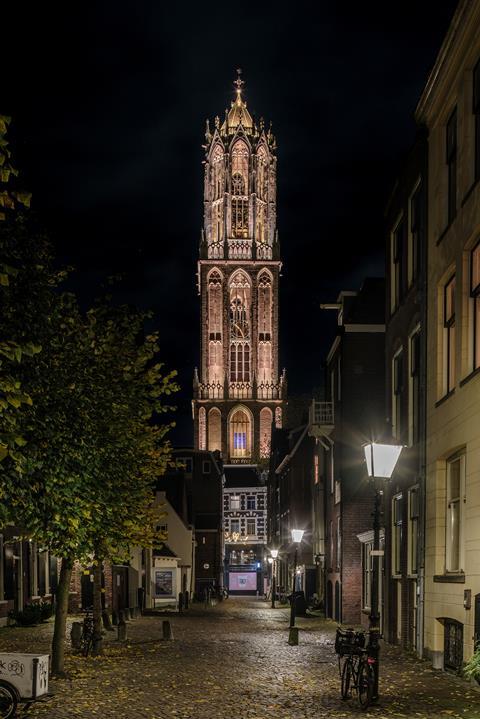
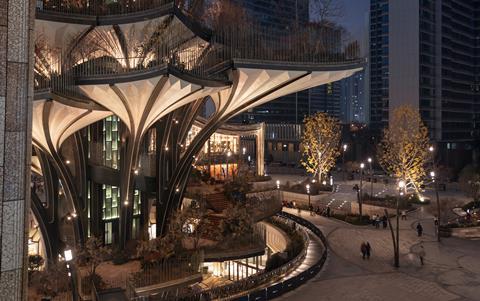
Recent projects include the British Pavilion at Expo 2025 in Osaka, where a perforated facade was animated at night to reveal a rippling Union Jack; and the lighting of the Dom tower in Utrecht, where a temporary art installation evolved into a magical permanent scheme that illuminates the building’s beautiful gothic architectural detail, largely from within. In China, at the Xi’an central and cultural business district, the Speirs Major team highlighted detailing in the Heatherwick-masterplanned design and subtly uplit the tree-shaped vertical park that is the centrepiece of the scheme, revealing its sculptural form to great effect.
As Bradshaw explains it, the core challenge today is learning how to do more with less. “People still want great atmosphere, great image, great character, great memories,” he says. “But that needs to be done with less energy, less resources.”
From abundance to restraint – what LED changed
The single biggest development shaping contemporary lighting practice in recent decades has been the widespread adoption of LED. Today, LED is the industry standard. “Even five years ago there were still remnants of older technologies that made it complicated to control one system with another,” Bradshaw explains. “That has all gone now. It is a fully integrated technology.”
But while LED unlocked new possibilities, it also brought unintended consequences. Efficiency gains made light cheaper and easier to deploy, and designers responded accordingly. Able to specify more lights, more cheaply, they did. Over time, this abundance became problematic. Bradshaw explains that traditional floodlighting, once the default for illuminating buildings and public spaces, is increasingly seen as poor practice, as concerns about sky glow and light spill have grown.
Then there is also maintenance to consider. “LED doesn’t last forever,” Bradshaw cautions. “Even if it does last, it still needs to be cleaned and accessed for maintenance.”
With LED now a mature technology, efficiency gains have begun to plateau, and the most significant gains are increasingly coming from controls, optics, dimming strategies and simply using less light. With marginal gains harder to achieve, attention has shifted from simply reducing wattage to questioning how much light is actually needed in the first place. This reassessment has become a key driver of current lighting trends, reframing lighting not as an unlimited resource, but as something to be deployed selectively and with intent.
Darkness as design tool
Central to the shift is a renewed emphasis on darkness. Contemporary lighting designers increasingly stress that light only has impact in relation to shadow, and that over-illumination erodes both atmosphere and meaning. At Speirs Major, the idea that light is precious – and should not be wasted – has become a guiding principle.
This thinking finds its clearest expression in the concept of the “dark city”, articulated by Mark Major, the practice’s co-founder and senior partner. “The dark city is not a place where people fear to walk,” he has said. “It is no more completely dark than a ‘dark sky’ is devoid of moonlight and starlight. Rather, a dark city aspires to reduce light pollution, light spill and energy use.”
Major describes a city where office lights are switched off when buildings are unoccupied, where sleep patterns are not disrupted by over-illumination, where biodiversity can coexist with human activity, and where darkness can still be experienced along rivers, in parks and gardens. In this view, lighting design is as much about deciding where not to add light as it is where to place it.
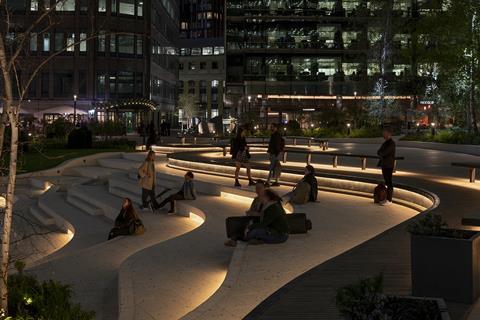
Lighting masterplanning has been central to translating this philosophy into practice. Speirs Major has developed lighting masterplans for cities including Cambridge, Durham and Newcastle, as well as large regeneration areas such as King’s Cross and the Greenwich Peninsula.
Internationally, the practice has worked on At-Turaif, the UNESCO-listed first capital of Saudi Arabia, where a warm, low-level scheme evokes flickering torchlight, and makes the settlement’s historic Najdi mudbrick architecture comprehensible rather than overwhelming it. Reflecting the importance of the lunar calendar in the Muslim faith, to mark each new moon, the external lighting shifts to a blue colour.
Resetting the city: Bhutan and the blank sheet
The opportunity to rethink lighting from first principles becomes particularly powerful in new cities, where inherited assumptions can be challenged. Bradshaw points to Gelephu mindfulness city in southern Bhutan as an example. Here a new eco-city is being masterplanned by BIG, with an emphasis on low-rise development, green infrastructure and biodiversity corridors to protect local wildlife such as migrating elephants.
“What is interesting from a lighting point of view is that we are not just copying international standards,” Bradshaw says. “Historically, urban lighting has been dictated by roadways. Street lighting formed the base layer of artificial light, driven by safety concerns around vehicles and visibility. Everything else was layered on top.
“When you start a new city, you can reset,” he continues. “That doesn’t mean we’re not lighting roads – but in terms of the amount of light, the brightness, the quality, the scale, it doesn’t have to be business as usual.” Instead, the ambition is to create a city connected to its environment, where the night sky remains visible and reflective materials are avoided for paving, to prevent light being thrown back into the atmosphere at night.
Major argues that lighting should be masterplanned and regulated in the same way as other aspects of the built environment. Alongside masterplanning that prioritises darkness as much as illumination, he identifies responsive controls – whereby lights adjust automatically to provide the right quantity, quality and distribution of light – and clear guidance and legislation as essential tools for moderating what he describes as the current “free-for-all” of artificial light.
Ecology and coexistence at Canada Water
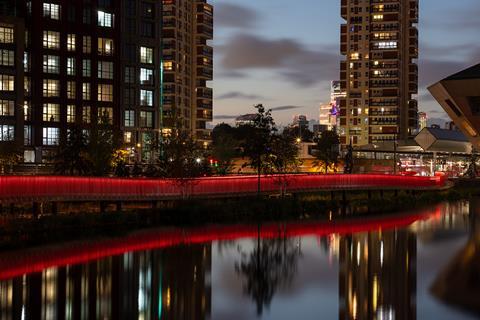
The ecological implications of lighting are increasingly shaping design decisions. Bradshaw highlights the lighting of a new boardwalk at Canada Water as a project that exemplifies this approach.
The bold, red, curved footbridge by Asif Khan snakes across the east London dock linking the tube station to new attractions around its edge. The structure is in a designated bat corridor, which required the lighting design to foreground the needs of the flying mammals.
Working with the site ecologist, Speirs Major developed a scheme that changes seasonally. In winter, when the bats are hibernating, the lighting comes on early in the evening at a warm 3000K, providing safe passage for commuters. As night falls, it gradually dims and warms further, emphasising the sculptural qualities of the bridge.
In summer, when the bats are active and commuting happens largely during daylight, the lighting comes on later, at minimal brightness and in a very warm colour to minimise ecological impact. “It looks amazing; it works from an ecological point of view; and it works for people in terms of safety and security,” Bradshaw states.
“This warm, soft light that the bats like – we humans enjoy it too. It is deeply programmed in us.” He notes that many species, from insects to small mammals, are less disturbed by warm light, whereas cooler light can cause disruption; and suggests that rather than switching lighting off entirely, the challenge is to find a balance that allows human activity and ecology to coexist.
Human experience without hype
Claims around “human-centric lighting” have proliferated in recent years, but the evidence base remains uneven. There remains widespread confusion between circadian science, wellbeing and marketing hype, leaving many designers wary of overpromising health benefits. Regulation, too, has struggled to keep pace with emerging research.
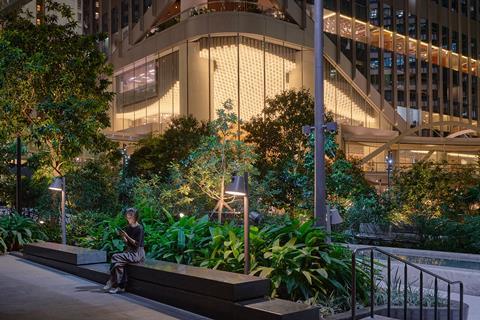
For Major: “Designing for comfort in exterior lighting is about fostering a sense of psychological safety and security.” This includes supporting intuitive wayfinding, good facial recognition and clear spatial legibility after dark. Selective lighting of entrances, routes and destinations creates environments that feel navigable and reassuring without resorting to blanket illumination.
Beyond physiological responses, Major argues that creative lighting has the potential to contribute to happiness by shaping atmosphere and experience.
Quality over quantity
Despite such shifts, lighting design is still often judged through blunt quantitative measures. Lux levels remain a dominant proxy for quality, while understanding of colour metrics varies widely. Meanwhile, late-stage value engineering frequently strips out nuance, undermining design intent.
Historically, the colour rendering index (CRI) has been used to describe how accurately a light source reveals colours, giving a single score out of 100 that became shorthand for “good” light. As LED lighting became widespread, however, CRI’s limitations became apparent. Based on a small, outdated set of colour samples, it can obscure significant differences in how materials, skin tones and saturated colours are rendered.
TM-30, developed by the Illuminating Engineering Society, responds to these shortcomings by using 99 colour samples and separating colour accuracy (Rf) from colour saturation (Rg). Its growing adoption reflects a broader shift away from compliance-led metrics towards a more qualitative understanding of light.
As Speirs Major’s work demonstrates, this has gone hand in hand with renewed interest in shadow, contrast and hierarchy as fundamental design tools – reasserting lighting as an aesthetic and experiential discipline rather than a purely technical one.
Controls, systems and maturity
Technological maturity has also reshaped expectations around lighting controls. In the past, systems were often over-engineered, poorly commissioned and inadequately explained at handover, leading occupants to override or disable them entirely. Software dependency and obsolescence compounded the problem.
Today, there is a move towards simpler, more intuitive interfaces. Lighting increasingly operates as part of a wider building intelligence layer, supported by sensors that gather meaningful data on occupancy and use patterns. “People still like to have a specific place to go on the wall for. lighting,” Bradshaw notes, emphasising the importance of tactile, ergonomic controls alongside digital interfaces.
Technical innovation, he suggests, has slowed to an incremental pace. “Things have stopped shrinking. Everybody wanted everything to be smaller and better – and now we have reached that point.” Rather than novelty, the focus now is on reliability, usability and long-term performance.
Integration, materials and honest conversations
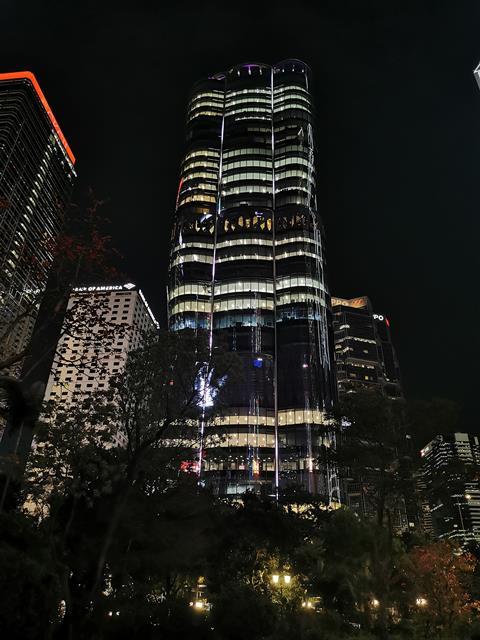
As understanding of light has grown, so too has the ease with which it can be integrated into architecture. “Building a cove, an edge detail, a slot detail, it’s all a lot easier than it used to be. As a profession, we have pretty much perfected those things,” Bradshaw says. For specialists, the challenge lies in finding new ways to integrate lighting into materials without compromising maintenance and repair.
Best practice in pursuance of best results requires lighting designers to be involved early – if possible when materials are being selected. Lighting performance is inseparable from material reflectance, making early, honest conversations essential.
Client expectations have also shifted. Where Pinterest once dominated, AI-generated imagery now sets increasingly unrealistic expectations. “Sometimes we have to say, ‘Yes, that looks cool, but it’s just not physically possible in real life’,” Bradshaw explains. Some clients working towards green certification might nonetheless bring images of energy-gobbling features such as backlit ceilings, which just won’t meet the required standards. For all these reasons, Bradshaw reiterates that clients and designers should start talking as early as possible.
Retrofit, reuse and regulation
Retrofit and circularity are as important in lighting as in any other aspect of the built environment today. Bradshaw describes growing interest in reusing existing equipment, although the legacy of bespoke, cut-to-fit systems from the 1990s and 2000s often makes this difficult. Going forward, modular systems offer the greatest potential for circularity, even if they impose certain constraints.
Regulation has yet to catch up with many of these realities. Current standards tend to prioritise energy performance over experience, and post-occupancy evaluation of lighting remains rare. Greater alignment between lighting performance and broader building outcomes, supported by evidence and feedback, could help reposition lighting as a core component of building performance rather than decoration.
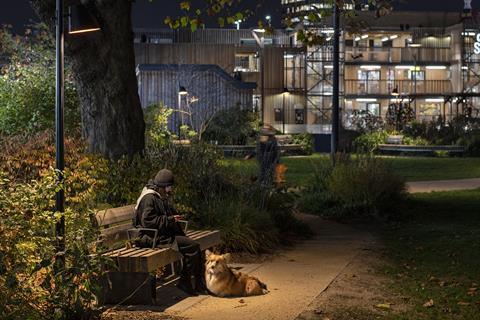
Less light, better light
Across all these strands – technology, ecology, human experience and regulation – a consistent message emerges: light is no longer something to be applied generously and indiscriminately. It is a precious resource, to be used sparingly, thoughtfully and with intent.
Speirs Major’s work suggests that the future of architectural lighting lies not in spectacle for its own sake (despite the pressures of our infinitely Instagramed age and of clients armed with AI image generation), but in restraint: fewer fittings, better placed; darker cities that remain legible and safe; and in lighting that enhances experience without dominating it. There can still be drama and beauty, just executed subtly. What “good” lighting looks like has changed.