Send us Feedback

Monday06 September 2010

Simon Conder's phoenix rising

  • Email
  • Comment
  • Save

The accidental demolition of a 1960s John Winter home in St Albans paved the way for a rather special replacement by Simon Conder Associates, reports Ellis Woodman.

It was, Simon Conder is at pains to assure me, an accident. Number 65 Marshal’s Drive was a single-storey brick pavilion, built in 1965, on a leafy street of large detached homes in St Albans. One of John Winter’s earliest projects, it stood as a brave ambassador of modernism in the spiritual heart of commuterland.

Approached four years ago by a young couple with two daughters who had bought the house with a view to upgrading and extending it, Conder developed a scheme that sought to address the structure’s myriad technical failings, the combined product of lousy build quality, zero maintenance, and the negligible thermal standards of the sixties. An unfortunate 1970s extension was to be removed and the perennially leaking roof needed replacing in its entirety, but the plan was to retain the walls of Winter’s building. A demolition contractor was brought in who duly set about removing the roof — with a JCB. The walls were knocked off plumb, the whole site ended up being cleared, and work had to begin from scratch.

What Conder has built, therefore, is effectively an extension of a house that no longer exists. Look carefully at his plan and you can make out the ghost of what was to have been retained: two walls, the one to the garden and the one that runs past the internal courtyards, correspond to the front and back faces of Winter’s house. Ironically, Conder did originally consider building completely anew but couldn’t get the image of the old project out of his head. Even though none of the 1965 fabric has been kept, the quasi-Miesian sensibility of that project is clearly detectable in its replacement. That connection has a great deal to do with the affection Conder and his client felt for the earlier house, but it is also a product of the common legal restrictions under which the two houses were conceived.

The site was originally part of the garden of the adjacent property, and when it was sold off as a building plot in 1965, certain covenants were incorporated into the deeds. Significant among these were stipulations that any new house should be single-storey and flat-roofed. Once the hedging had matured at the front of Winter’s building, it was all but invisible from the road. Conder’s project, set behind a high fence of horizontal iroko slats that will eventually become a green wall, is scarcely less discreet. Gauged against the neighbouring post-arts-and-crafts houses on Marshal’s Drive, it could hardly be called contextual, but its passage through the planning process in this most conservative of towns proved remarkably straightforward.

The plan is neatly bisected by a corridor that extends on axis with the front door. Bedrooms and bathrooms lie to one side, the living areas — including studies for the parents who both work part-time from home — lie to the other. The house is over 20m deep and runs the full width of the plot, so without the two internal courtyards the rooms in the middle would have been deprived of daylight. However, the interior feels anything but claustrophobic. The courtyards are joined by an enclosed south-facing garden at the front, and a really very generous one at the back, which is dominated by a large oak tree stood immediately adjacent to the building line. The presence of nature is always close to hand, yet the neighbouring houses scarcely intrude on one’s field of view.

Conder seems to thrive when presented with a fantastically testing budget

Blessing in disguise

Houses on Marshal’s Drive sell for in excess of £1 million, but because of the condition of the 1965 property, Conder’s clients paid much less. Nonetheless, they weren’t left with a vast budget with which to build. The total cost was £312,400 for an internal floor area of 230sq m, representing a far from lavish £1,358 per sq m. Given this considerable constraint, the loss of the John Winter fabric seemed a disaster, but it turned out to be a blessing in disguise. Once the project became a new build rather than an extension, the client was able to save 17.5% VAT on the cost of materials.

Conder is one of those architects who seems to thrive when presented with a fantastically testing budget. He talks fondly of a rooftop conservatory his practice built for £15,000, its sheets of polycarbonate held together with double-sided sticky tape. One can trace that same delight in assembling prosaic materials with unusual refinement in its best known project, the Black Rubber House at Dungeness in Kent.

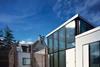
There is certainly no fat on the St Albans scheme: walls are blockwork, faced in insulating Sto render, the floor is in hand-trowelled concrete and the roof is in Sarnafil. Exposed softwood joists support the roof, and softwood studs support the vertical glazing.

Means and ends

The house is, Conder claims, the last his practice will design with a boiler

The two main living spaces are taller than the others, with the extra height established by a stud-framed clerestory. The location of the studs and roof joists are synchronised, creating a cage-like assembly which — particularly given that the only applied finish is a milky white stain — demanded exceptionally precise workmanship. The first joiner approached threw up his hands in horror, but the end product is everything that could be hoped for.

The architect wanted to silicone-bond the glass directly to the wood, but couldn’t get a warranty for such a basic solution. A stainless-steel top-hat section has therefore been fixed directly to the stud, with the glass siliconed to that. From inside, all we see is glass and timber, while from outside the black bands of silicone have a very graphic reading against the white Sto render.

Crucially, there isn’t an opening window in the house. Ventilation is provided by solid-core door blanks set into the end elevations, and also into the glazed walls of the two courtyards that puncture the deep plan. The house’s internal transparency is one of its great pleasures, and the door blanks have been carefully offset from one another to maximise the available views. As refined as his bespoke glazing solution undoubtedly is, Conder estimates that it came in at half the price of using a thermally broken aluminium system with opening lights.

Through its strict economy of means, the house achieves something rather different from the minimalist tone of some of its architect’s higher budget commissions. The rabbit hutches, inherited furniture and other paraphernalia of family life sit comfortably here rather than feeling like infractions of a tyrannically imposed aesthetic.

Intriguingly, in the years since it was designed Conder has become something of an evangelist for sustainable design, and the house is, he claims, the last his practice will design with a boiler. More recent projects make more conscious use of solar gain and the heat-retentive capacity of the fabric to ensure they achieve zero-carbon status. One suspects that these concerns will gel very happily with the sensibility on display at St Albans.

Like the Black Rubber House, what particularly impresses about this project is its elemental quality. Conder’s new-found environmental agenda promises to consolidate this most compelling strain of his work.

Related company resources

Have your say

You must sign in to make a comment

sign in register
  • Email
  • Comment
  • Save