






The newly completed Preston Vault Youth Zone marks the final chapter in more than a decade of civic renewal work in the city for John Puttick Associates, which was originally founded to refurbish the famous Brutalist bus station across the road from this striking new youth centre
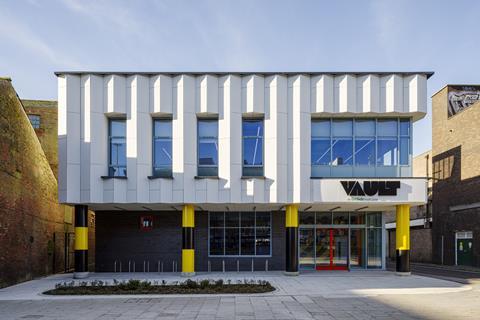
The vibrant, contemporary new space for young people was designed and delivered by the firm for national youth charity, OnSide. It completes a trio of projects by the London-based architects at the site – the wider site masterplan, incorporating public square landscaping works, as well as the original award-winning restoration of the Brutalist icon.
The Vault reflects Preston’s ambition to strengthen its civic ecosystem and provide a long-term resource for the city’s young people. It is the latest addition to the Harris Quarter, the city’s cultural and civic centre. Funding for the wider regeneration programme was supported by the government’s Towns Fund, the Youth Investment Fund and Preston City Council. The project is also the nineteenth Youth Zone in the OnSide network – and the fourth delivered by John Puttick Associates. The next one will soon be on site in Thurrock.
City centre location
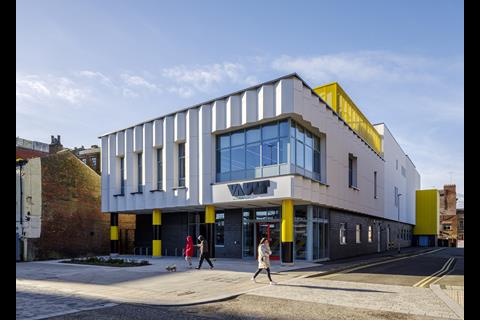
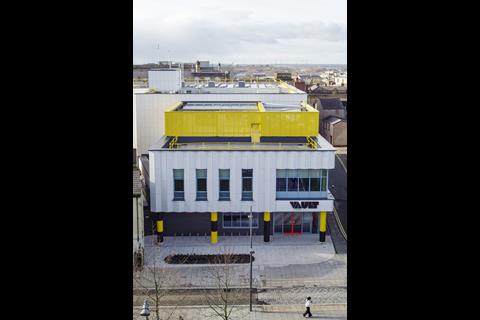
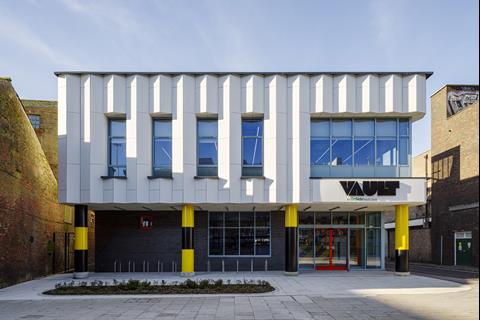
The Vault Youth Zone demonstrates how architecture can blend playfulness with seriousness of purpose; accessibility with civic presence; and regeneration with authentic community use. Positioned in the centre of Preston, it is easy to reach – its location is crucial to its success and growing membership. The central location also encourages active travel and public transport use and embeds the facility into the civic life of Preston. The standout yellow-colonnade entrance faces directly onto the public square and bus station, and acts as a welcoming beacon for young people.
Contraints of the plot
The building’s form and layout were influenced by the constraints of the tight urban plot and the need to accommodate large internal volumes, including a full-sized sports hall. The designers stacked the spaces, positioning the sports hall and indoor kick pitch towards the most sheltered part of the site, locating taller volumes where they would have less visual impact on the surrounding streetscape. This approach allows Vault to rise away from the street, respecting the scale of the adjacent Grade II listed warehouse.
Bus station facing
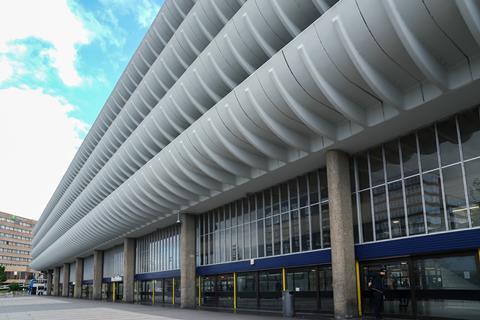
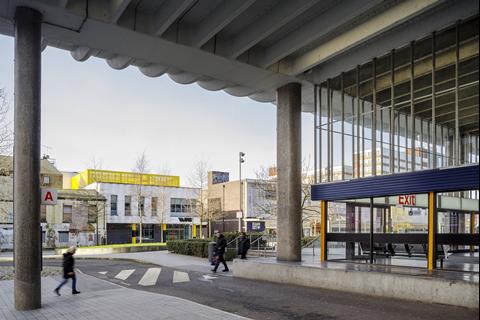
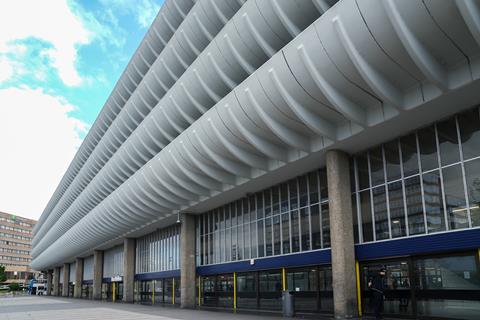
The architects also had the challenge of creating a contemporary building facing the dramatic bus station opposite. The bus station – designed by Keith Ingham and Charles Wilson of BDP, with EH Stazicker and with engineering by Arup – is an icon of northern Brutalism.
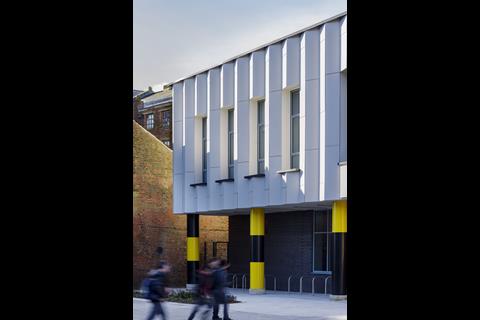
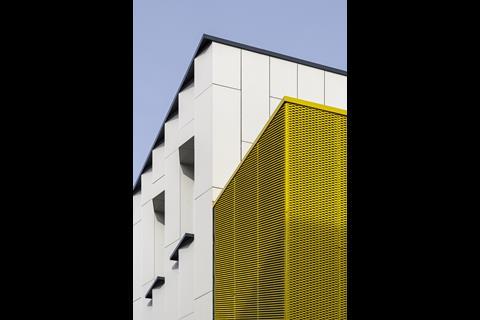
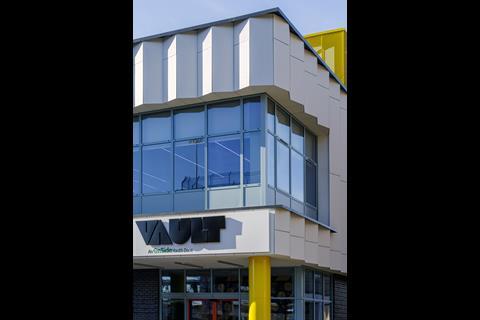
Vault Youth Zone establishes a respectful relationship with the bus station, adopting a related but lighter and more playful language. The facade is clad in light grey fluted fibre cement panels that appear almost white in sunlight, catching light and shadow across the folded geometry – a rhythm that reflects the vertical ribs on the bus station’s concrete decks, creating a clear visual dialogue between the two buildings.
Yellow-and-black columns and yellow metal mesh wrapping the terrace and fire escapes pay homage to the bus station’s original yellow steelwork, and give the Vault a recognisable identity that is both characterful and rooted in its place. An overhang at the entrance, supported by the bright yellow-and-black columns, makes a meeting point for members to gather before visiting together.
Hacienda designer
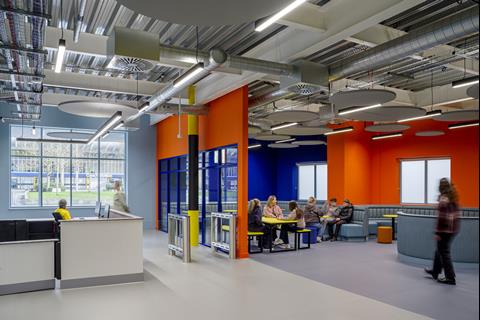
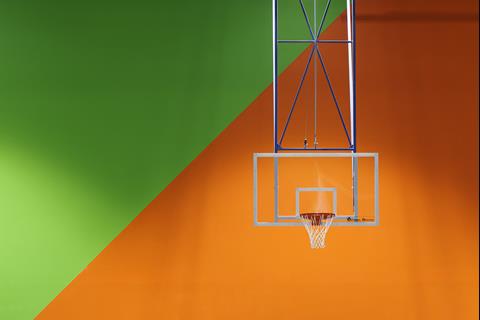
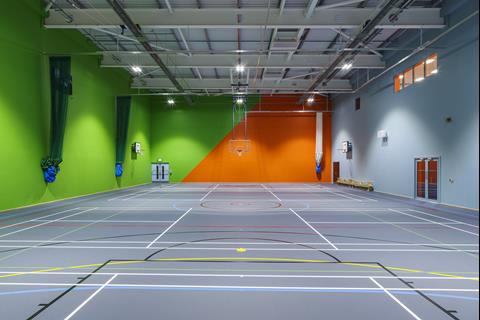
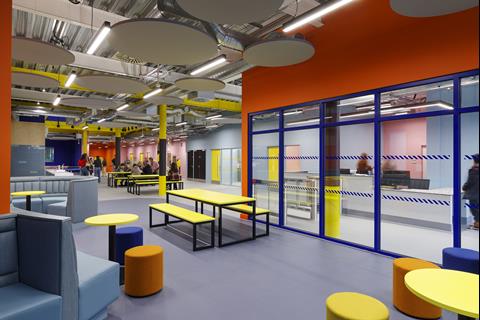
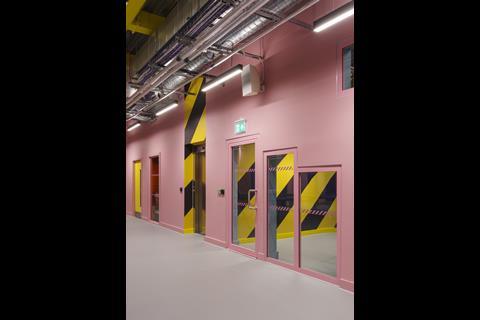
The bold colourful interior design was developed by the architects in collaboration with the renowned designer of Manchester’s famous Hacienda nightclub, Ben Kelly. Kelly, whose work fuses industrial aesthetics with graphic systems, was a pioneer of graphic-led interior environments, blending wayfinding, branding and architecture. Here the vibrant colours and robust materials are arranged to communicate clearly defined zones as well as spaces for varying moods and activities. Kelly’s compositional approach to bold colours works perfectly with the sculptural qualities of the modernist bus station and the bold linear design of the Vault.
Social spaces
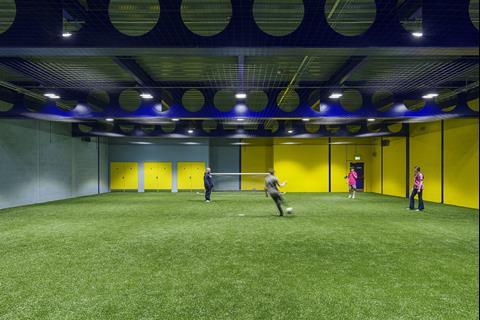
The ground floor functions as a social heart of the building, bringing together the main recreation space complete with cafe, mentoring kitchen, arts and crafts room, makers’ space, gaming zone, boxing gym and indoor kick pitch. Inclusion and enterprise rooms offer quieter spaces for focused activity and support.
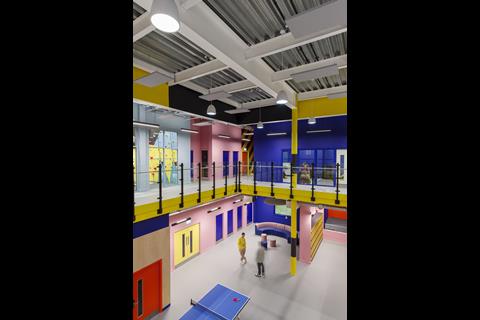
The first floor accommodates larger-scale facilities, including the sports hall, climbing wall, fitness suite, performing arts centre, music and recording rooms, podcast studio, health and wellbeing room, changing facilities and one-to-one spaces. Staff offices and a secure rooftop terrace, enclosed by the yellow mesh, occupy the second floor.
The double-height central void and climbing wall play a key role in shaping the experience of the building, visually linking floors while allowing passive supervision. The openness helps users navigate intuitively and feel safe.

Sustainability and resilient design
The structural steel frame is optimised to reduce material use, and the building has highly airtight and insulated construction combined with windcatchers for natural ventilation. Photovoltaics reduce operational energy demand.
This project demonstrates how youth centres can successfully bring vibrance to prominent city centre sites as inclusive civic landmarks. OnSide is a national charity with the stated aim that all young people should have the opportunity to discover their passion and their purpose – “To find out what they’ve got and where it could take them.” It funds and builds Youth Zones in the country’s most economically disadvantaged areas, offering as many as 20 activities a night, ranging from football and climbing to media, DJ-ing, drama and employability training, with entry costing just 50p.
Bus station reno winners
John Puttick Associates was founded in 2014 with a competition-winning entry for the refurbishment of Preston’s bus station, which reopened to the public in 2018 to critical acclaim. (The project was longlisted for the Stirling prize, and won the 2021 World Monuments Fund/Knoll Modernism prize.) So the opening of the Vault represents the culmination of a long relationship with the city for the firm.
John Puttick, director at John Puttick Associates, said, “Vault Youth Zone is the culmination of our 10-year engagement with the regeneration of this part of Preston. The refurbished bus station, public square and Youth Zone work well together to provide an animated and community-focused area of the city. We are delighted to see young people given such a prominent location, and to see them engaging with the many activities on offer in the Youth Zone.
Tim Jacques, chief executive officer at the Vault, said, “This is a worthy companion for our world famous bus station. There is real momentum with Preston’s city centre redevelopment, and I believe the Vault is an important piece of this work, representing the potential of our young people and through them, our city’s future.
“The feedback from young people so far has been invariably positive, commenting on the vibrancy, flow and how Tardis-like it feels. We want this building to be their safe space, where they connect, grow, create and ultimately thrive. This magnificent building is therefore so much more than just a building.’’
Project details
Gross internal floor area 2,912m2
Site size 2,330m2
Construction cost £8.9 million
Architect John Puttick Associates
Form of contract/procurement route Design & Build (JPA novated)
Client OnSide Youth Zones
Structural engineer Ramboll (design stage), Caulmert (construction stage)
M&E consultant Hurstwood Environmental Consulting
QS Walker Sime
Project manager Walker Sime
Principal designer CDM PD Jacob Feasey Associates
BR PD John Puttick Associates
Fire consultant Clarke Banks
Approved building inspector Clarke Banks
Main contractor Triton Construction
CAD software used Revit, MicroStation
Environmental performance and sustainability data
On-site energy generation19%
Annual mains water consumption 1.82m3/occupant
Airtightness at 50pa3.5m3/h.m2
Heating and hot water load 86.02kwh/m2/yr
Overall area-weighted U value 0.33w/m2k
Annual CO2 emissions 13.2 KgCO2eq/m2
Energy performance certificate rating A
Postscript
All Vault photos by Gareth Gardner




No comments yet