
Consumerism and environmental concerns make awkward bedfellows at China’s Shanghai Expo
Shanghai expo
Expo Park
Shanghai, China
Until October 31
3/5 stars
If you thought the Beijing Olympics was a big deal, think again. That was sport, and the Chinese don’t really do sport.
They prefer building and nationhood. In Shanghai, they do superlatives too. You barely have time to take in the citys’ ambition as you catch the world’s fastest train (267mph) to go to the world’s highest bar (on the 92nd floor).
So it follows that the Shanghai Expo, at over 5sq km, is by far the largest ever held, costing £27 billion (a cool 35 times more than the Millennium Dome).
If you didn’t make it to Seville, Hanover or Zaragoza, you may be wondering what an expo is. Essentially temporary visitor attractions, these mini cities are made up of many pavilions instructing the public, often peddling a brand of a place (in the case of Shanghai, 192 countries and 50 organisations, from Liverpool to Bolivia) with an outside hope that trade and investment is a by-product. An expo in Shanghai creates the perfect storm for national one-upmanship, as everyone trips over each other for a bite of China’s economic growth.
With China’s history of isolation and its current interest in the world outside, Shanghai Expo’s heady pick and mix of cultural meaning and identity is fascinating and exciting – I saw a film featuring shots of Buenos Aires, Beijing and Edmonton to the soundtrack of Land of Hope and Glory, and a cartoon in the Saudi Arabian pavilion, with men in robes and keffiyeh and women in hijab, in the style of South Park. Nothing European appears sacred, and Asia’s take on the west is increasingly following its own rules.
In response to the theme of “better city, better life”, European countries in particular have gone to town to assert their cultures. Whether wacky Dutch houses, Spanish Rattan waves, Danish cycle ramps, or the Italians’ frenetic attempt to find ways to present pasta with excitement (how about back lit, or in massive tubes?), walking around the European area is like being in the company of over-stimulated toddlers desperate to get attention.
You move on with a headache and the feeling that the minor differences being conveyed between European cultures are lost on the predominantly middle-class Chinese audience. The nascent power and confidence of the 368,249 visitors on the day I was there was palpable, and their interest in Europe clearly only selective.
In this context, Heatherwick’s elegant British pavilion comes across as understated and classy. Let’s hope it’s not too subtle and that the Chinese who lean towards restraint are the ones who award the contracts. Certainly on the day I was there, the brasher pavilions – Germany, Japan – were getting the lion’s share of visitors, with three-hour queues to enter.
But given our continent’s pride in its urban culture, how do the European pavilions contribute to the “better cities” theme? While it is easy to promote individual green initiatives in an exhibition, on the bigger scale it’s all rather like being at an architectural jumble sale.
It is trippy in a way, but the fun fades somewhat when you remember that the buildings aren’t second-hand, but brand new – and that the majority of pavilions, despite the occasional recycling fillip, have a life span of precisely 182 days.
So, the overall impression from the Shanghai Expo isn’t of “better” anything. It is of waste. The choice of theme highlights the fact that the whole thing is just so incredibly, shockingly profligate. It is not just the buildings – many of which are better built than Luton airport or a BSF school – there’s the site itself. The project is located near the centre of Shanghai, in an area that previously was active urban fabric. Development involved clearing 18,000 families and 270 factories, including the busy Jiang Nan Shipyard, which employs 10,000 workers.
Then there’s the set dressing. The sheer quantity of paraphernalia deployed to the (ultimately unsuccessful) attempt to soften and unify the architectural maelstrom is overwhelming: many thousands of peonies, peace lilies, benches, lighting, hundreds of trees – not only saplings but mature ones – none of which are necessarily where anyone will want them in six months’ time.
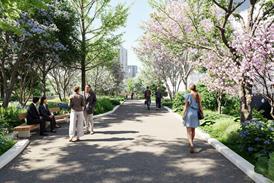
So what are better cities anyway? There are no real answers here. The road crash of sustainability and development takes place at every level: a pavilion with the strapline “extend city dreams” belongs to the China National Petroleum Corporation; the lauded low-carbon covered green spine, to enable pedestrians to move around comfortably in the sticky Shanghai summer, turns out in reality to be a vastly over-engineered steel and concrete flyover covered by square kilometres of vinyl flooring and edged with hothouse plants already wilting on day 30.
Don’t get me wrong. I am not against festivals and celebrations. I could go as far as thinking there isn’t something daft in making buildings with an 182-day lifespan, if there are wider pay-offs. And of course, like Britain in 1851 and Spain in 1992, China is on the up, and good luck to it.
But let’s not pretend sustainability has anything to do with it. With a new coal-fired power station opening every two weeks in China, the ostentatious display of solar panels, and the hectoring request for the public not to use disposable chopsticks (in order to “save our urban planet”) is insultingly hypocritical.
Some might baulk at the preference of Chinese visitors to glimpse a late-model BMW over being instructed to solve the world’s problems. But amid such vacuous greenwash, who can blame them for that?
Original print headline - Costing the earth


No comments yet