





The Pangolin Shield is one of the highlights of this year’s London Design Festival: an installation that speaks poetically of colonial legacies and ecological exploitation, but also offers a positive message about the transformative power of creativity – not to mention some practical lessons about the structural possibilities of bamboo
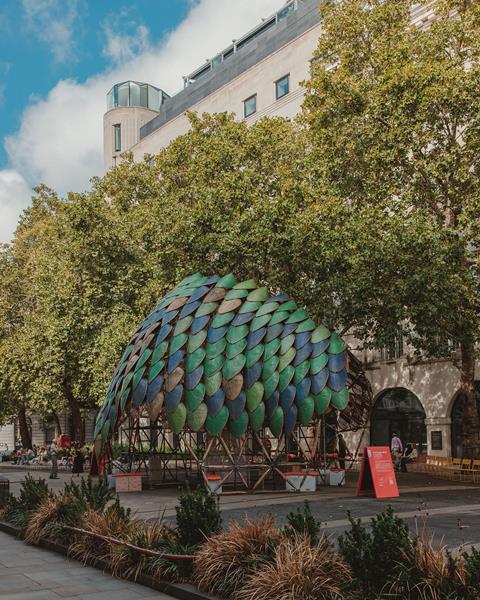
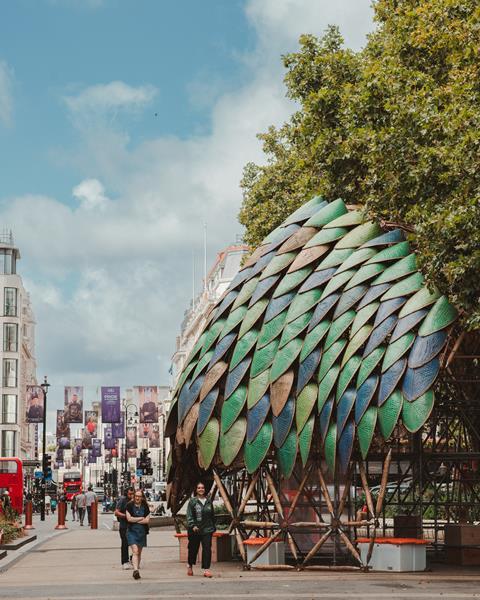
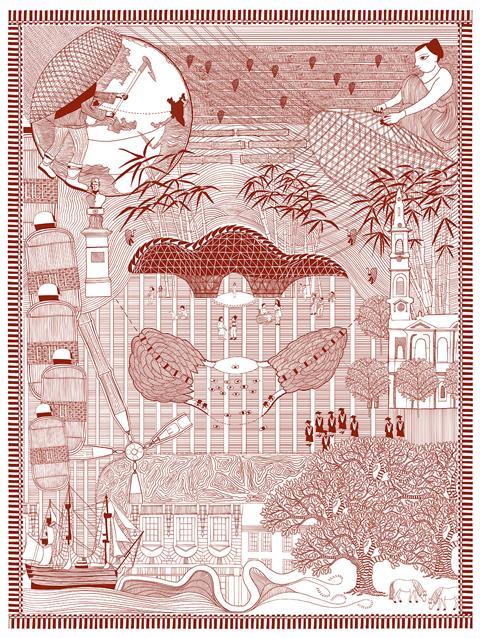
The structure, which is the product of a collaboration between architects Studio Saar and structural engineers Atelier One, is fashioned from bamboo police riot shields and traditional bamboo rain shields known as knups. Its form pays poignant homage to the endangered pangolin, the most trafficked mammal in the world.
The structure resembles a giant pangolin crouching on The Strand at the confluence of ley lines of colonial history – between the Indian High Commission, formerly the office and residence of the High Commissioner for India, and Somerset House, which was home to the Navy Board during the era of the East India Company.
Endangered inspiration
Talking about the choice of animal for the structure’s form, Ananya Singhal – co-founder of the British-Indian practice Studio Saar with Jonny Buckland, who he met at the University of Bath – explained that he is a passionate wildlife photographer and that the pangolin is one of his favourite creatures. But it is also one that is under threat from human exploitation – making it an appropriate symbol to represent the vulnerability of the natural world.

Singhal describes the cruel irony that the creature’s “armour” – the scales designed to protect it – are the very thing that has made it unsafe thanks to the illegal wildlife trade. The scales are made of keratin – the same material as human fingernails or rhino horn – and, ground up, they are considered a key ingredient in traditional Chinese medicine. Pangolin meat is also a delicacy at high-end restaurants in parts of Asia. This demand means that all eight species of pangolin are now threatened, with four listed as critically endangered or endangered.
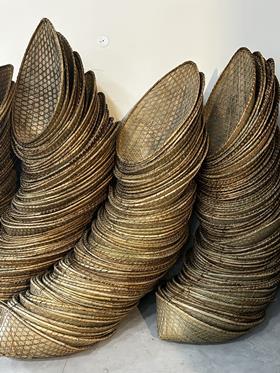
This poignant backstory informs the design of what could be considered the “pangolin pavilion”. Indian influence comes in the shape of the scales made from knups, a traditional teardrop-shaped body-covering worn in Meghalaya, in the north east of the country, one of the wettest places on earth. Made from palm leaves and a local variety of bamboo called slew, these woven hoods protect workers in the fields during heavy rains. Here – some of them incorporating non-traditional plastic – they form the colourful scales across the curve of the pangolin’s “back”.
Police riot shields put to peaceful purpose
Another part of the curved roof is crafted from the Indian police riot shields invented under British rule. These are made from lathis, bamboo sticks synonymous with the “lathi charge”, a baton charge that has been a fixture of Indian crowd-control policing since the colonial era. In a message of hope, a place of shelter and sanctuary has been created by repurposing objects designed for subjugation.
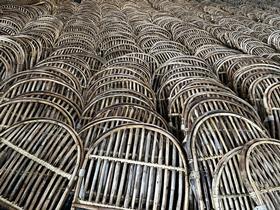
Singhal explains, “They were invented to keep the Indian population down when they were rioting in what we call the first War of Independence – and what you call the Great Mutiny. That shows the difference in perspective.”
The future’s bamboo
The shields and knups are fixed to a curved frame made of bamboo. One of the goals for the team in delivering the project was to demonstrate that bamboo can be used in a more engineered, industrial way as well as in craft-based contexts.
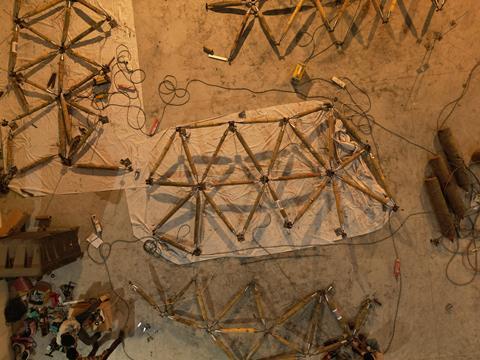
The frame was made from modular parts put together in India and shipped to London for assembly near the bust of Nehru next to India House. Lengths of thick bamboo were formed into the triangular modules using specially designed metal connectors, and these were then joined together to create sections of the structure.
All-important connections
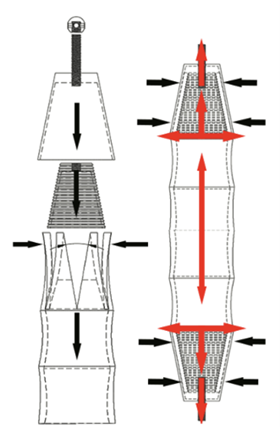
Professor Neil Thomas, founder and director of Atelier One, is keen for the structure to be a demonstrator of the versatility of bamboo in construction. He said, “As a firm, we’ve been working with bamboo for a long time, and one of the difficulties is how you bring it together to create forms in a way that is transferable. So we’ve been developing these connectors, through research and a comprehensive understanding of the complex properties of this natural material. We’ve now arrived at a point where technology allows us to work with the beautiful vagaries of nature by using a series of connectors, and it is exciting to be taking forward the possibilities through a series of projects around the globe.”
The connectors, or nodes, allow thick bamboo stems to be joined together quickly and easily to create structures without the need for labour-intensive hand tying. Atelier One has developed them working with bamboo expert Jörg Stamm. To date they have been made from turned aluminium, but the Indian-UK collaboration in this project enabled a new approach.
The value of international collaboration

Singhal explains that the economics of production are opposite in India and the UK, “Labour is expensive in the UK, so here you give this to a machine and the machine makes it. In India, labour is not really expensive, it’s the material that is expensive.” Handmaking the connectors in India reduced the weight and the cost dramatically – so the new models are about one tenth the price and about one fifth the weight. Singhal adds, “That was one of the beautiful things about the way we were able to work together on the development of this project – we actually ended up co-developing the engineering.
“And this is not the end, even what we put up here is not the end point. This is a prototype, it’s the first prototype of a few more iterations that we’re going to make of structures and of the connectors to make them as efficient as possible, as light as possible. Because we believe that they have great potential for use in all sorts of spaces from emergency relief structures to concerts and large venues which can be put up and taken down very quickly. I think there’s a lot of potential here – we just need to make sure that we can make the system as easy to use as possible.”

Thomas founded structural engineering practice Atelier One in 1989. The firm is known for bridging art, architecture and event design; its portfolio spans Anish Kapoor’s Cloud Gate in Chicago, the ABBA Arena in east London, Gardens by the Bay in Singapore, Federation Square in Melbourne, and stage engineering for artists like U2 and the Rolling Stones.
Atelier One’s most celebrated work with bamboo to date is The Ark, the Green School gymnasium in Bali where they worked with Stamm and project designers Ibuku to find new ways to use the fast-growing material. The award-winning open-sided structure is a series of interdependent bamboo arches stitched together by anticlastic grid shells in a biomimetic design inspired by the ribcages of mammals.
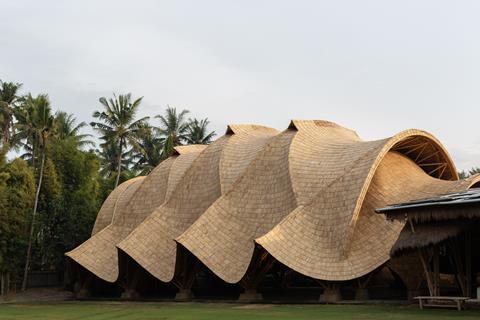
Thomas says, “Bamboo is seen as a labour-intensive Asian material. And that’s because some of the greatest bamboo buildings in the world have these beautifully tied connections. They take a lot of time and effort and a lot of skill. What we’ve been able to show with some of the things that we’ve made and with the stand connectors is that we can move beyond that. We can move beyond this humancentric, craft-related methodology for bamboo and connect pieces together in a more mechanistic way that would work in Europe, for America – in places where [the other methods would be] intensely expensive.”
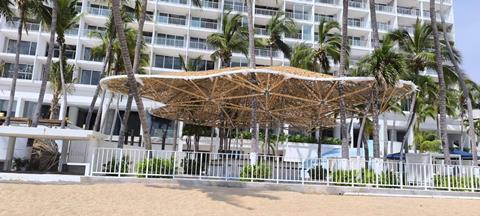
Seven-storey bamboo tower
He believes that we are only at the beginning of seeing the potential of bamboo in construction, pointing to the seven-storey Ninghai Bamboo Tower made from prefabricated bamboo components and cross-laminated bamboo-timber (CLBT) as a sign of where things are heading. Closer to home, he points out that bamboo already thrives on the Isle of Wight and in Cornwall and believes that, thanks to climate change, it will be able to be cultivated over much of the country in the future.
Studio Saar has studios in Somerset and Udaipur, India. This is not its first bamboo-based pavilion in the capital: in 2023 the practice designed the Craft Not Carbon pavilion in Crystal Palace Park as part of the London Festival of Architecture that featured a roof made using woven bamboo mats. The firm’s wider portfolio includes projects in both countries and encompasses intelligent residential projects that blend the best of contemporary and traditional regional Indian design, as well as factories, community and cultural buildings.

The pangolin works at many different levels, as a lyrical comment on our exploitative past and present, but also as a sculptural embodiment of hope in the form of a new low-carbon construction technology. Catch it while you can.
The Pangolin Shield is on The Strand at WC2R 1ES until Sunday 20 September.







No comments yet