






Matthew Lloyd looks back at the long life and career of his friend Adrian Gale, who died in July
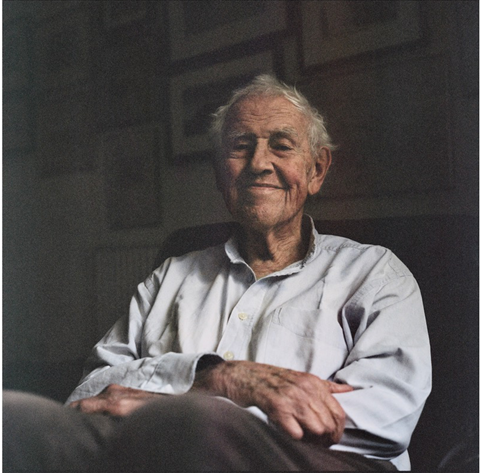
Adrian Gale was a practitioner, professor and critic with a career spanning over 60 years. He was part of a movement and network of architects that came to dominate UK architectural thinking and production in the second half of the 20th century. But, unlike so many of his prolific friends, it was not his output of buildings that characterised him, but his intellect and connectivity, coupled with a unique warmth and generosity which left an indelible mark on the architects and students who knew him.
Gale’s early contact with the modern movement set him on a path and stylistic position that never left him. Born in 1931 in Edenbridge in Kent, he trained at the Architectural Association in the early 1950s and with a student group took Le Corbusier out to lunch in London during the RIBA Gold Medal celebrations.
He travelled to America, where he worked firstly in San Francisco and later crossed to Chicago to the studio of Mies van de Rohe. He met Frank Lloyd Wright too during this time. Through these interactions, Gale was one of the very last of a generation to have directly experienced the very milieu responsible for that most important architectural style of our age.
Back in London, Gale worked for Douglas Stephens & Partners, one of the most influential modernist practices in the capital and met among others there the historian Kenneth Frampton, who became a lifelong friend and colleague. Gale then started in small private practice, coupling this with more public positions, teaching at Kingston in the late 70s and early 80s and serving for a time as president of the AA.
He freestyled architectural education through an absolute love and belief in his subject, but also significantly through his sheer affability
In 1983 Gale saw the opportunity to switch into education full time, becoming professor of architecture at the then Plymouth Polytechnic, soon afterwards the University of Plymouth. Here I first met Adrian in the early 1990s – after he had somewhat rashly employed me at an interview at the Pizza Express by the British Museum to become a junior lecturer in his department. We were friends ever since, right up and until his passing this late July.
Adrian, often known as Adie, was utterly one of a kind as both a personality and a teacher. He freestyled architectural education through an absolute love and belief in his subject, but also significantly through his sheer affability.
It wasn’t that he broke the rules – he didn’t know any rules. His department was affectionately known as “the white school of the west” because of his singular position and intellect. He invited all the best architects of the day down to that far away outpost – and they always came and were lavishly entertained– to engender an ambition and a spirit within the studios that architecture was a noble, central and vital profession to be getting in to.
It was all Adrian: he himself made a unique place there, during a unique time.
After he left Plymouth in 1996, Gale became the head of school at the Prince of Wales’s Foundation for Architecture and the Urban Environment. This was unexpected and attested to his social connections, but also his offer to make that fabled department more relevant to the present day.
His tenure was short-lived, however, and his only real legacy from that period was the finding and subsequent refurbishment of the foundation’s east London headquarters, a Victorian warehouse at 19-22 Charlotte Road in Shoreditch. This building, equally unexpectedly designed by our young practice at Gale’s suggestion, is still in the same successful use today – although Shoreditch is no longer the frontier to the east that it once was.
He understood the culture of our subject and its expectations, setting a standard of quality and an exacting sense of what was right and wrong
In Gale’s later years he mixed a degree of retirement with his wife, the judge Audrey Sander, while travelling to and critting at the University of Bath right into his eighties and still sitting on various panels and juries.
Adrian Gale leaves a distinctive legacy in a now fracturing and confused architectural profession. He understood the culture of our subject and its expectations, setting a standard of quality and an exacting sense of what was right and wrong.
His architecture was one of clarity, simplicity, even modesty. The simplicity of a white circular column and the offset wall running past: to understand Adie Gale’s DNA was to properly understand what Mies’s Barcelona Pavilion was designed to demonstrate and say.
Gale’s opinion as an observer of architecture really mattered. How would he judge a building’s quality; would he have looked out of the corner of his twinkling eye with approval or with a little doubt? He would never have understood or given space to post-modernism. His own domestic interiors had a clarity of purpose, describing utility but also distinctive craft.
Ultimately you could unpack Gale’s position into the simple democratisation of architecture, the removal of the elite or brash or expensive or opulent. Therefore, in his heart, what modernism could be described as being for: the creation of an architecture of the people, by the people and for the people.





3 Readers' comments